A backpack is the only piece of gear whose correct answer depends entirely on the gear you already own. The same pack that carries one person's kit beautifully will dig into another's shoulders, not because it is a worse pack but because their tent weighs two kilograms more. So the method below starts with your scale, not with a shortlist.
Why the pack goes last
Pack weight and carry comfort pull against each other, and the thing that decides where you land is your base weight. A frameless pack can weigh under 800 g and carries 25 lb well; a full-suspension pack carries 40 lb well and weighs over 2 kg. Neither is better. The one that is right for you is set by what goes inside it.
That is why experienced hikers buy the pack after the shelter and the sleep system, and why buying it first is the most common expensive mistake in backpacking. If you buy a 65 L framed pack to hold a heavy kit and then replace the kit, you own a pack that is now half empty and a kilogram heavier than you need. Start with what base weight means, and the big three explains why the pack is the piece you settle last.
Step 1: weigh what you already own
Put everything you carry on a kitchen scale except food, water and fuel. That total is your base weight. Then add the consumables for the trip you actually take most often:
- Food: most hikers plan on 1.5 to 2 lb per day.
- Water: 2.2 lb per liter. Two liters is about 4.4 lb.
- Fuel: a canister plus its steel shell, which is heavier than the gas figure on the label.
Base weight plus consumables on day one is the number the pack has to carry. A 20 lb base weight with three days of food and two liters of water is about 30 lb; a 28 lb base weight on the same trip is about 38 lb. Those two hikers need different packs, and nothing else on this page matters more than which one you are. For the fuel side of that total, how long a fuel canister lasts has the real packed weights. How heavy should my backpack be works through the arithmetic properly, including the old 20%-of-body-weight rule and what it is worth.
Step 2: let the published load rating pick the frame
Every serious maker publishes a recommended load range or maximum load. Use it as a hard filter, because it is the one spec that describes whether the pack can do the job at all.
| Your day-one load | What to buy | Example and its published rating |
|---|---|---|
| Under 25 lb | Frameless, or a removable frame sheet | Granite Gear Virga3 55: 25 lb rating, 762 g (1 lb 10.9 oz) |
| 25-35 lb | A light frame | Granite Gear Crown3 60: 35 lb with the frame sheet, 1,080 g (2 lb 6.1 oz) |
| 30-35 lb | A light frame with a ventilated back | Osprey Exos 58: 30-35 lb, 1,320 g (2 lb 14.6 oz) |
| 35-45 lb | Full suspension, or a light frame built for load | Osprey Atmos AG 65: 30-40 lb, 2,092 g (4 lb 9.8 oz); Durston Kakwa 55: 45 lb max, 895 g (1 lb 15.6 oz) |
Over the rating, a pack does not break. It stops transferring weight to your hips, and the load lands on your shoulders and lower back instead. That is the sensation people describe as “this pack hurts,” and it is usually a loading problem rather than a pack problem.
Note the one genuinely interesting row: Durston rates the Kakwa 55 to 45 lb at 895 g (1 lb 15.6 oz), which is 1,197 g (2 lb 10.2 oz) lighter than the Atmos AG 65 for a higher published maximum. Light and load-capable is no longer a contradiction, it is just expensive. The frame question in full is frameless vs framed backpacks, and Exos 58 vs Atmos AG 65 is the same trade inside one brand.
Step 3: measure your torso, not your height
Two people the same height can be two pack sizes apart, and a pack one size too long will not transfer load no matter how you adjust it. If you are at the short end — under about 16 in — your options narrow fast, and short-torso fits are worth seeking out deliberately. Our backpack sizing guide has the measuring method and the size charts, and petite-fit packs and packs for tall hikers cover the two ends.
Then check the hipbelt range separately. The belt carries the weight, and belt circumference is listed independently of torso length: Kelty gives 28-50 in on the Asher 55, Granite Gear's Crown3 Re-Fit belt covers 26-42 in. A pack that fits your back and not your hips is the wrong pack.
Step 4: size the volume to real trips, not to the longest one you imagine
Volume is the number people shop by and the one that matters least, because an under-filled pack carries badly and a pack stuffed past its load rating carries worse.
- 40-50 L: weekends with a light kit, or thru-hiking once your base weight is genuinely low.
- 50-60 L: the sweet spot for most three-season backpacking, including a week of food.
- 60-70 L: a bear canister, winter insulation, carrying for two, or a kit that has not been trimmed yet.
One honest caveat on the numbers: makers measure volume differently and some count external pockets. Durston lists the Kakwa 55 as 55 L internal plus 15 L external for the Medium; 3F lists the QiDian as “40 L + 16 L” and, on the same page, “up to 55 L.” Compare internal volumes where you can, and treat a 10 L difference between brands as noise. What size backpack you need goes trip length by trip length.
If a bear canister is in your future, decide that now: it is the single bulkiest object most backpackers ever carry, and it is the usual reason someone needs 65 L rather than 55 L.
Step 5: the features that are actually fit
Most pack features are preference. These four change how the pack carries.
- Hipbelt pockets. Two, ideally. This is where snacks, your phone and a map live, and a pack without them sends you digging in the lid at every break. Kelty's Asher 55 has one, on the right, which is the sort of detail spec sheets bury.
- A ventilated or suspended back panel. Keeps your shirt drier and adds weight. Osprey's AirSpeed on the Exos and AntiGravity on the Atmos are the mainstream versions; frameless packs put a foam panel or your sleeping pad against your spine instead.
- Torso adjustment. An adjustable harness (Kelty's FIT-Pro, Granite Gear's adjustable Virga3 torso, Osprey's 4 in of AirSpeed adjustment) lets one pack fit a range, which matters if you are buying online and cannot try it loaded.
- A roll-top or a removable lid. Both let the pack shrink around a smaller load. The Exos's lid comes off entirely and its built-in FlapJacket closes the top without it.
Everything else — daisy chains, ice-axe loops, hydration sleeves, a dozen compression straps — is weight you carry on every step whether you use it or not. How you load the pack matters more than any of it: how to pack a backpacking backpack.
Four packs across the range
One per step of the ladder: the budget framed pack, the ventilated lightweight, the configurable mid-weight, and the frameless pack with real sizing. Every figure is the maker's own, and all four are measured against our reference pack, the Osprey Rook 65 at 1,678 g (3 lb 11.2 oz) (Osprey).
Our picks for this
A pack per load range
Not a ranking. These four show what each step of the frame ladder buys, and each is scored properly on the pack roundups.
Best budget framed pack
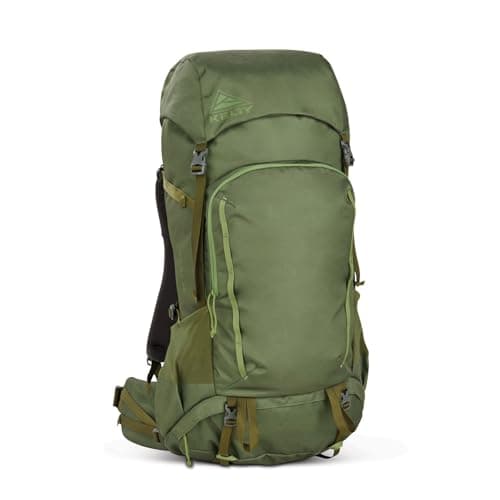
Kelty Asher 55
1,420 g (3 lb 2.1 oz)$150–$200 band4.0 / 101,420 g with a perimeter frame, FIT-Pro torso adjustment and a published 25-45 lb carry range. The cheapest framed pack here that still beats the reference weight; one hipbelt pocket.
$169.95Amazon#ad · Price as of November 3, 2026 · Affiliate disclosure for the link to Kelty Asher 55
Best ventilated ultralight pack
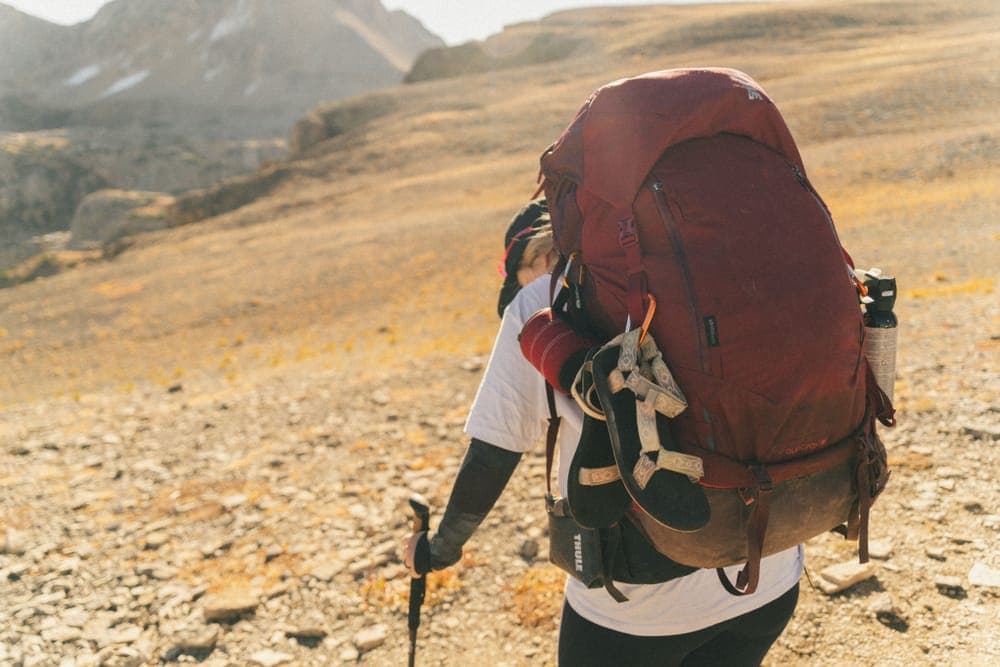
Osprey Exos 58
1,320 g (2 lb 14.6 oz)$200–$300 band4.6 / 101,320 g with a LightWire frame and a suspended mesh back, a removable lid and Osprey's any-reason guarantee. The load range stops at 35 lb.
Check price · Amazon#ad · Price as of November 3, 2026 · Affiliate disclosure for the link to Osprey Exos 58
Most configurable lightweight pack
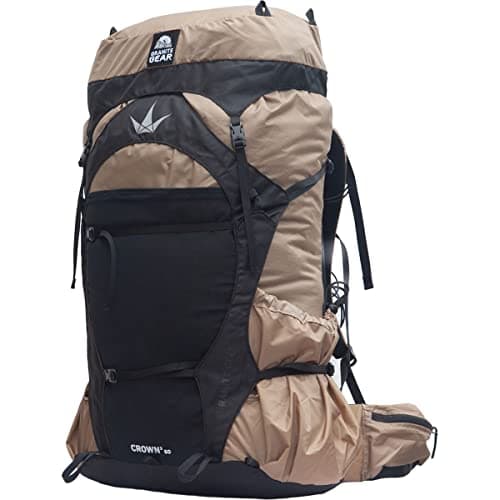
Granite Gear Crown3 60
1,080 g (2 lb 6.1 oz)$200–$300 band5.2 / 101,080 g and 60 L with a removable frame sheet: 25 lb without it, 35 lb with it, 43 lb with the optional stay. The most configurable pack of the four.
Check price · Amazon#ad · Price as of November 3, 2026 · Affiliate disclosure for the link to Granite Gear Crown3 60
Lightest pack with torso sizing
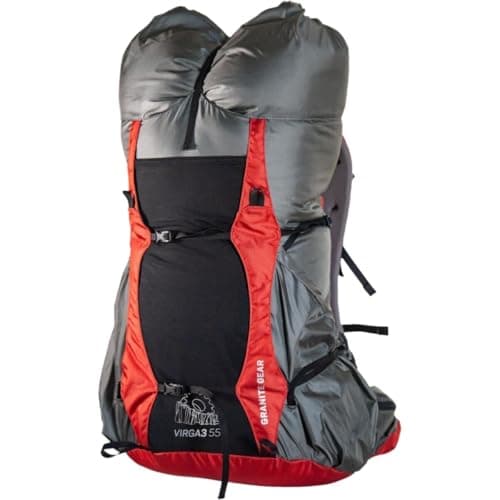
Granite Gear Virga3 55
762 g (1 lb 10.9 oz)$150–$200 band6.2 / 10762 g, 55 L, frameless with an adjustable torso and a lifetime warranty. Rated to 25 lb, so it only works once the rest of your kit is light.
$199.95Amazon#ad · Price as of November 3, 2026 · Affiliate disclosure for the link to Granite Gear Virga3 55
Photos are illustrative, not the product. Scores are spec-derived.
Where each sits on our grams-per-dollar math, with the rest of the field, is in the best budget ultralight backpacks and the best budget backpacking backpacks.
What not to pay for
Volume you will not fill. The commonest upsell at a shop counter, and the one that makes a pack carry worst.
A heavier pack to carry a heavier kit. This is the trap worth naming twice. The Teton Scout 55L lists at the lowest price of any framed pack we track and weighs 2,041 g (4 lb 8.0 oz) — heavier than the Rook 65 reference, so it saves nothing at all (Teton). As a first pack for a borrowed kit that is a reasonable trade. As a long-term answer, it means buying a pack because your tent is heavy, instead of fixing the tent. Our freestanding tent ranking and X-Mid 2 vs Duplex show where shelter grams actually come from, and Vesper 20 vs Revelation 20 does the same for the sleep system.
Cottage fabrics you do not need. Ultra and UltraGrid laminates are genuinely light and genuinely expensive. A 100D or 210D nylon pack from a mainstream brand with a real warranty is the better first purchase for almost everyone — Kelty, Granite Gear and Osprey all cover defects for the life of the product or better.
A rain cover. Buy a trash-compactor bag and line the inside of the pack. It is lighter, cheaper, and it keeps your quilt dry even when the pack itself is soaked.
Three mistakes
1. Buying the pack first. It is the last of the big three to buy, because it is the only one whose spec depends on the other two.
2. Shopping by liters. Load rating and torso length decide whether a pack works. Volume decides whether your food fits.
3. Ignoring the published load range because a pack is on sale. The cheapest sub-kilogram pack we track, the 3F UL Gear QiDian 40+16 at 850 g (1 lb 14.0 oz), is rated to 12 kg (26.5 lb) and comes in no torso sizes. That is a genuinely good pack for a hiker whose kit is already light, and a miserable one for a beginner with a 2 kg tent. Same pack, two opposite verdicts, and the only thing that changed is what went inside it.
How we scored this
How these picks were chosen
Every weight and list price here comes straight from the maker's own product page, measured against a named mainstream reference, then turned into one number: grams saved per dollar. Every figure links to the page it came from, so you can check any of it in a click.
Value and weight are computed from those published numbers; function, durability and ease are scored from the specs, manuals and standards each maker publishes. Commissions never set a score or decide a pick. The formula, weights and references are published.
What changed
- Published.
Questions
Frequently asked
What size backpack do I need for backpacking?
How do I know if I need a framed or frameless pack?
How do I measure my torso for a backpack?
How much should a backpacking backpack weigh?
Is an expensive backpack worth it for backpacking?
Should I buy my pack before or after the rest of my gear?
Receipts
Sources
- Osprey: Rook 65L product page, the pack reference (checked 2026-09-22)
- Osprey: Exos 58 product page, Specifications (checked 2026-09-22)
- Kelty: Asher 55 product page, fit and carry range (checked 2026-09-22)
- Granite Gear: Crown3 60 Unisex product page (checked 2026-09-22)
- Granite Gear: Virga3 55 Unisex product page (checked 2026-09-22)
- Durston Gear: Kakwa 55 product page, sizing and max load (checked 2026-09-22)
- Teton Sports: Scout 55L product page (checked 2026-09-22)
Weights, list prices and specs on this page come from each maker's own pages, linked on every product, and performance figures such as boil times or flow rates are the maker's claims, labeled that way, so you always know whose number you're reading. Amazon sets its own prices and changes them often, so buy buttons link to the live listing. Read the full method.