Every gram a pack maker adds for a frame is a gram it isn't saving you. That trade only makes sense if the frame buys something back: a higher load rating, a more comfortable carry at the loads you actually hike with, or both. Some frames earn it. Some barely do. The maker's own numbers tell you which is which — you don't have to guess.
What a pack frame actually does
A frame's job is to move weight off your shoulders and onto your hips, where your body carries load far more comfortably. REI's own sizing guide puts a number on how much: “The majority of a backpack's weight—80 percent or more—should be supported by your hips” (REI Expert Advice). A rigid frame, usually an aluminum stay or a molded sheet against your back, is what lets a stiff hipbelt do that job under a real load. Take the frame away and that transfer gets harder to pull off, which is why frameless packs lean on something else for structure: a folded sleeping pad or a foam sheet slotted against your back, doing a smaller version of the same job.
The hardware that does this is the load lifter straps running from the top of your shoulder straps back to the frame. REI describes how they should sit once cinched: “They will snug the top of the pack in closer to your body, which should lead to a more comfortable carry and get the weight off your lumbar,” and “ideally, the load lifters will form a 45-degree angle between your shoulder straps and the pack” (REI Expert Advice). That angle only exists to pull against because there is something rigid inside the pack to pull against. A soft, frameless pack has no fixed point for the load lifters to work with, which is exactly the comfort trade you're making by going frameless.
REI is direct about that trade-off in its own buying guide: “Ultralight devotees who like to hike fast and light might choose a frameless pack or a climbing pack where the frame is removable for weight savings,” but “packs without a frame are much more uncomfortable under heavy loads” (REI Expert Advice). “Heavy” there is relative to the pack's own rating, not some universal number, which is why the load rating on the spec sheet matters more than the frame-or-no-frame label on the box.
That is also why a frame's value shows up directly in the maker's published max load rating, not just in the weight on the spec sheet. A heavier frame doesn't automatically mean a higher rating, and a frameless pack doesn't automatically mean a low one — it depends on the specific design. Our guide to how heavy your backpack should be covers where that rating fits next to the usual body-weight rule of thumb; this page is about what earns you a better one.
When frameless works
Frameless works when two things are both true: your base weight is already light, and your fully loaded pack stays comfortably under the maker's rating. The 3F UL Gear QiDian Pro is explicit about the trade: it is frameless because “a folding sleeping pad serves as the back panel,” rated to 14 kg (30 lb), and 3F's own page states it as a design choice, not an oversight (3F UL Gear). Skip it if you sleep on an inflatable pad with nothing foam to slot in — without one, the pack has no structure left at all.
The Granite Gear Virga3 55 shows a more finished version of the same idea: still frameless, with a sleeping pad sliding into interior panels for support, but sized to your torso (Regular 18–21 in, Long 21–24 in) and rated to 25 lb (Granite Gear). That rating is the ceiling to plan around, not your base weight alone: add food, water and fuel for your trip length before you compare the total against it.
For a budget buyer, the frameless case isn't just about grams. The gap between a frameless pack and a traditional framed one is often the difference between two whole line items in a build, and every dollar not spent on a frame you don't need is a dollar that can go toward a lighter tent or quilt instead — gear that usually moves your base weight more per dollar than the pack does. That only holds if the load rating actually covers what you carry; a frameless pack that gets overloaded stops being a bargain the first uncomfortable mile in.
When a frame earns its grams
The Durston Kakwa 55 is the clearest case of a frame paying for itself. Its removable aluminum frame and backpad together add roughly 105 g — 90 g for the frame, 15 g for the pad — and in exchange the whole pack carries a 45 lb max rating, the highest of any sub-kilogram pack in our registry (Durston Gear), while the complete pack still weighs 895 g (1 lb 15.6 oz). That is what “earning its grams” looks like: a small, specific weight cost for a large, specific gain in what you can carry.
The Granite Gear Crown3 60 makes the same case a different way: it publishes three separate load ratings for one pack, depending on how you configure it. Without its removable frame sheet, Granite Gear rates it to 25 lb. With the frame sheet in, 35 lb. Add the optional aluminum stay, sold separately, and it reaches 43 lb (Granite Gear). You can watch the frame's contribution move the ceiling in real time on the same pack.
Not every frame clears that bar. The Osprey Rook 65 — our Osprey Rook 65 reference, the mainstream framed pack every lighter pick here is measured against — weighs 1,678 g (3 lb 11.2 oz) and doesn't publish a load range on its product page at all (Osprey). And the Kelty Asher 55, a genuinely budget framed pack with a 25–45 lb optimal carry range, only saves about 258 g (9.1 oz) against that same reference (Kelty). A frame that raises the rating without shedding much weight, or that doesn't say what it's rated for at all, isn't pulling its own weight the way the Kakwa's does.
Framed doesn't always mean heavy
“Framed” is not one thing. The Osprey Exos 58 carries a real 4 mm powder-coated LightWire frame and an AirSpeed suspended mesh back panel, the same category of hardware you'd expect on a heavy traditional pack, but it does it at 1,320 g (2 lb 14.6 oz), squarely in ultralight territory, and rates to 30–35 lb. Osprey's own spec pages disagree with each other on the exact figure by 32 g, which the Exos card on our roundup discloses rather than picking one and hiding the conflict (Osprey). See how that frame stacks up against the Kakwa's lighter one in Osprey Exos vs Durston Kakwa 55.
Put the three framed packs in this guide next to each other and the pattern is clear: a frame's weight and its rating don't move together in lockstep. The Kakwa's aluminum stay adds roughly 90 g and buys a 45 lb rating. The Exos's LightWire frame and suspended mesh add real structure at an ultralight weight but a lower, 30–35 lb rating. And the Rook 65's frame, heaviest of the three, buys no published rating at all. More frame hardware doesn't automatically mean a higher number on the spec sheet — it means whatever that specific maker built it to do.
Four packs, four frame strategies
Fit rides along with load rating, not separately from it: REI notes hipbelts “usually accommodate a wide range of hip circumferences, from mid-20 inches to mid-40 inches or so” (REI Expert Advice), and that holds across these four: the Virga3 and Crown3 both publish a 26–42 in belt range, the Kakwa spans 29–42 in across its two belt sizes, and the QiDian Pro states only a minimum waist (over 28 in) with no upper limit given. A frame that's rated to carry more is worth little if the hipbelt underneath it doesn't fit the load onto your hips in the first place.
Side by side, sourced from each maker's own spec page:
| Published spec | 3F UL Gear QiDian Pro | Granite Gear Virga3 55 | Granite Gear Crown3 60 | Durston Kakwa 55 |
|---|---|---|---|---|
| Weight | 880 g (1 lb 15.0 oz) | 762 g (1 lb 10.9 oz) | 1,080 g (2 lb 6.1 oz) | 895 g (1 lb 15.6 oz) |
| List price | $50–$100 band | $150–$200 band | $200–$300 band | $200–$300 band |
| Max load | Up to 14 kg (30 lb) | 25 lb | 25 lb without frame sheet, 35 lb with it, 43 lb with the optional aluminum stay (sold separately) | 45 lb |
| Frame | Frameless: a folding foam sleeping pad serves as the back panel | Frameless suspension; a sleeping pad slides into interior panels for support | Removable Vapor Current Mark 3 PE frame sheet with molded foam back panel | Hollow aluminum inverted-U frame (removable) |
| Value | Value 8.7/10 | Value 4.6/10 | Value 2.3/10 | Value 2.8/10 |
| Score | 7.0 / 10 | 6.2 / 10 | 5.2 / 10 | 6.0 / 10 |
Our picks for this
Frameless to framed, in order
Four ways makers trade grams for carrying capacity, from a folding pad standing in for a frame to a full removable aluminum one.
Best value frameless pack
3F UL Gear QiDian Pro
880 g (1 lb 15.0 oz)$50–$100 band7.0 / 10No frame at all: your own folding foam pad does the structural work. Rated to 14 kg (30 lb) and priced accordingly.
Check price · Amazon#ad · Price set by Amazon · Affiliate disclosure for the link to 3F UL Gear QiDian Pro
Lightest pack with torso sizing
Granite Gear Virga3 55
762 g (1 lb 10.9 oz)$150–$200 band6.2 / 10Still frameless, but torso-sized and pad-supported by design, not improvised. Rated to 25 lb.
Check price · Amazon#ad · Price set by Amazon · Affiliate disclosure for the link to Granite Gear Virga3 55
Most configurable lightweight pack
Granite Gear Crown3 60
1,080 g (2 lb 6.1 oz)$200–$300 band5.2 / 10A removable frame sheet you can leave out to save weight or add back for load: 25, 35 or 43 lb depending on how you build it.
Check price · Amazon#ad · Price set by Amazon · Affiliate disclosure for the link to Granite Gear Crown3 60
Best load carrier under 1 kg
Durston Kakwa 55
895 g (1 lb 15.6 oz)$200–$300 band6.0 / 10A full removable aluminum frame for about 105 g, pushing the rating to 45 lb, the highest here by a wide margin.
See it at Durston GearSold direct by the maker, not on Amazon. Plain link: we don't earn on it.
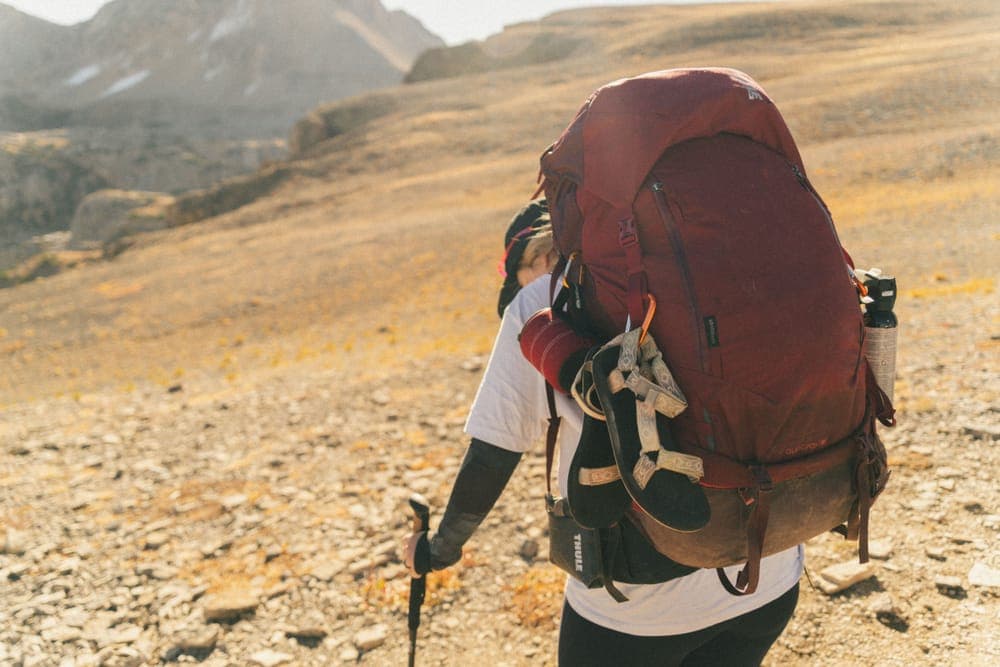
Photos are illustrative, not the product. Scores are spec-derived.
What this means for a budget kit
Run through these before you decide, in order:
- Start from your base weight, not the pack. A frameless pack only makes sense once the rest of your kit is already light enough to stay under its rating.
- Add your actual loaded weight — base weight plus food, water and fuel for your usual trip length — and compare it to the maker's published rating, using the same method as how heavy should my backpack be.
- Check what's doing the structural work on any frameless pack you're considering: if it needs a folding foam pad to hold its shape, make sure that pad is already in your kit, not an add-on cost.
- Don't assume more frame means more rating. The Rook 65 and the Exos 58 both carry real frames and publish very different numbers; read the spec page for the specific pack, not the category it's sold in.
If your kit is already trimmed down and your typical trip stays short, a frameless pack with a published rating well above your loaded weight is real money saved for no practical downside. Our best budget ultralight backpacks roundup ranks that whole field, frameless and lightly framed alike, by grams saved per dollar. If your base weight is still heavier, your trips run long or cold, or you just haven't gotten your kit down yet, a traditional framed pack is the safer buy while the rest of your gear catches up — see our best budget backpacking backpacks roundup for that side of the market.
How we scored this
Units we claim to have tested: 0
Most gear sites say they tested everything. We didn't, and we say so. What we did instead: took every weight and list price from the maker's own page, measured each product against a named mainstream reference, and computed grams saved per dollar. Every number links to where it came from.
The score is spec-derived: value and weight are computed from those numbers, and the rest are judgments from published specs, not test results. Commissions never set a score or decide a pick. The formula, weights and references are published.
Questions
Frequently asked
Frameless or framed backpack: which should I buy?
Do I need a frame if my base weight is already light?
Can a sleeping pad replace a pack frame?
Is a heavier framed pack always more comfortable?
Do ultralight framed packs exist, or is it frameless-or-heavy?
Receipts
Sources
- REI: "How to Choose a Backpack: Sizing & Fit Guide", REI Expert Advice (checked 2026-09-22)
- 3F UL Gear: QiDian Pro Backpack product page (checked 2026-09-22)
- Granite Gear: Virga3 55 Unisex product page (checked 2026-09-22)
- Granite Gear: Crown3 60 Unisex product page (checked 2026-09-22)
- Durston Gear: Kakwa 55 product page (checked 2026-09-22)
- Osprey: Rook 65L product page, Specifications (checked 2026-09-22)
- Kelty: Asher 55 product page (checked 2026-09-22)
- Osprey: Exos 58 product page, Specifications (checked 2026-09-22)
We haven't tested the gear on this page and we don't pretend to. Weights, list prices and specs come from each maker's own pages (linked on every product), and performance figures such as boil times or flow rates are the maker's claims, labeled that way. Amazon sets its own prices and changes them often, so buy buttons link to the live listing. Where a figure isn't published, we say so. Read the full method.