Almost every pack that hurts was bought on the wrong number. Shoppers compare liters, brands and reviews, and then buy a size based on their height — which no maker's size chart is actually built on. Torso length and height are only loosely related: two people the same height can be four inches apart in the measurement that matters.
This page is the two measurements, a chart built from figures makers publish on their own product pages, and what to do when you land between sizes. It is about fit. If you are trying to work out how many liters you need, that is what size backpack for backpacking.
The two numbers that set your size
How to measure your torso
- Stand up straight and tip your chin down to your chest. Run a finger down the back of your neck until you feel a bony bump that sticks out more than the rest. That is the C7 vertebra, and it is the top of the measurement.
- Put your hands on your hips with fingers forward and thumbs pointing back, pressing in until you feel the shelf of bone. That is the iliac crest. Your thumbs now mark a line across your lower back.
- Have someone run a soft tape from the C7 bump, following the curve of your spine, down to the imaginary line between your thumbs. Keep the tape against your back the whole way.
- Read it in inches. Write it down. That one number rules out most of the market in thirty seconds.
Do it twice. A half-inch error will not change the size you buy, but a two-inch error will, and it is easy to make by measuring to the trouser waistband instead of the bone.
How to measure your hips
Wrap the tape around yourself at the top of the iliac crest — the same bony shelf you just found, roughly two to four inches above where a belt sits. Keep it level, breathe normally, and read the circumference in inches.
This figure is almost always larger than your trouser size, and that is not an error. Hipbelt ranges are generous: the packs on this page quote belts from 26 in up to 60 in. The number matters most at the extremes — a slim hiker with a 28 in crest needs a belt that closes that far, and some do not.
The size chart
There is no industry-standard pack size chart, so the only honest version is one built from what makers publish. Every figure below is read on the maker's own product page or owner's manual and linked in the sources.
| Your torso | Size usually called | Packs that publish a range covering it |
|---|---|---|
| 15-16 in | Extra small / Short | Granite Gear Crown3 60 (Short, 15-18 in); Kelty Glendale 65 (15-21 in); Teton Scout 55L (15-19.5 in) |
| 16-18 in | Small | Crown3 60 (Short); Kelty Asher 55 (15.5-21 in); Teton Scout 55L; Osprey Exos 58 (S/M, 17-20.5 in) |
| 18-20 in | Medium / Regular | Granite Gear Virga3 55 (Regular, 18-21 in); Crown3 60 (Regular, 18-21 in); Exos 58 (S/M); Asher 55 |
| 20-21 in | Medium-large | Virga3 55 (Regular or Long); Crown3 60 (Regular or Long); Exos 58 (S/M to 20.5 in, or L/XL from 19.5 in) |
| 21-23 in | Large | Virga3 55 (Long, 21-24 in); Crown3 60 (Long, 21-24 in); Exos 58 (L/XL, 19.5-23 in) |
| 23-24 in | Extra large | Virga3 55 (Long); Crown3 60 (Long) |
Two things to notice. The ranges overlap, which is why “medium” is meaningless across brands. And above 23 in the field collapses to two packs — which is the whole argument of our packs for tall hikers page.
Women's-fit packs generally run shorter in the torso and curve the hipbelt and shoulder straps. Granite Gear publishes its women's Crown3 60 separately for that reason, and the field is ranked on best ultralight backpacks for women.
Packs at each end of the chart
Four packs that between them cover 15 in to 24 in of torso, so you can see what each end of the chart looks like in practice. Every weight and fit range here is the maker's own.
Our picks for this
One pack for each row of the chart
Picked for the fit range they publish, not for being the best pack overall. The full rankings are linked below each one.
Lightest pack with torso sizing
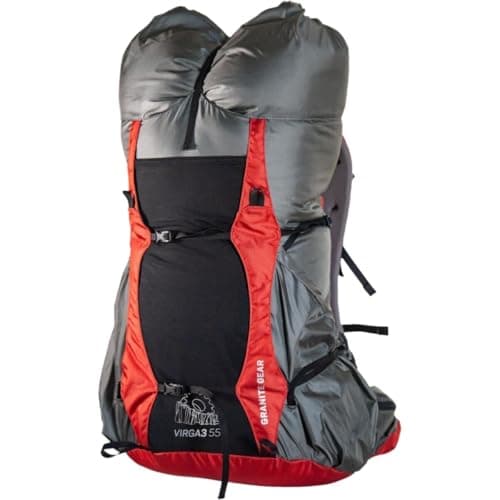
Granite Gear Virga3 55
762 g (1 lb 10.9 oz)$150–$200 band6.2 / 10Adjustable torso in two sizes, 18-21 in and 21-24 in, so it covers the top of the chart at under 800 g. Load rating is 25 lb, which is the real limit on it.
$199.95Amazon#ad · Price as of November 3, 2026 · Affiliate disclosure for the link to Granite Gear Virga3 55
Most configurable lightweight pack
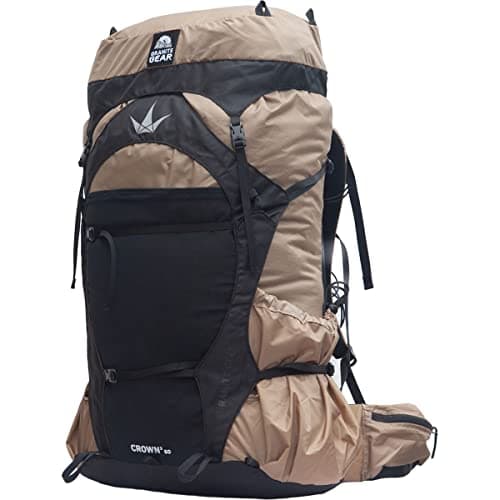
Granite Gear Crown3 60
1,080 g (2 lb 6.1 oz)$200–$300 band5.2 / 10Three fixed sizes covering 15-24 in, with a removable frame sheet rated to 35 lb. The widest published fit range of any pack we track.
Check price · Amazon#ad · Price as of November 3, 2026 · Affiliate disclosure for the link to Granite Gear Crown3 60
Best budget framed pack
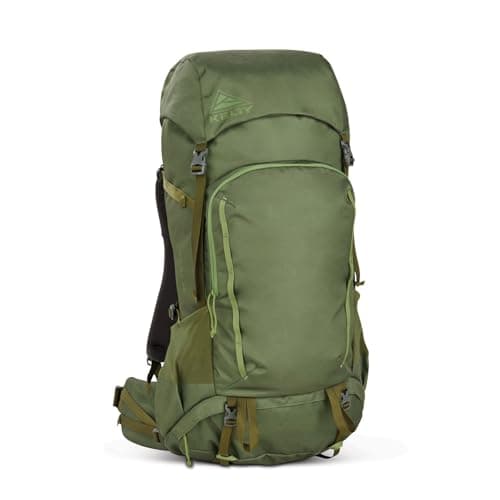
Kelty Asher 55
1,420 g (3 lb 2.1 oz)$150–$200 band4.0 / 10One adjustable size spanning 15.5-21 in with a 28-50 in waist belt, at the lowest list price of the framed packs here.
$169.95Amazon#ad · Price as of November 3, 2026 · Affiliate disclosure for the link to Kelty Asher 55
Cheapest framed pack for short torsos
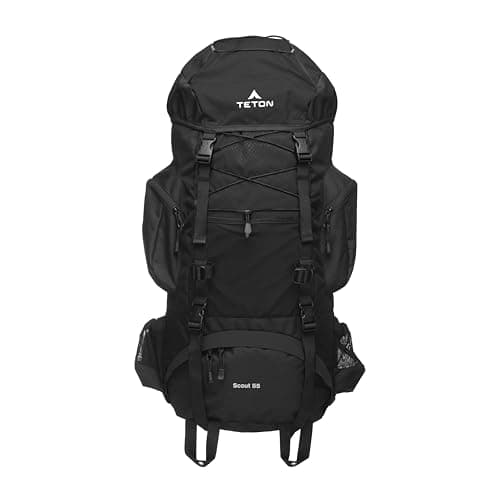
Teton Scout 55L
2,041 g (4 lb 8.0 oz)$50–$100 band2.7 / 10A 15-19.5 in torso and a 26-60 in belt: built for shorter torsos and wider hips, and the cheapest way into a framed pack.
$99.99Amazon#ad · Price as of November 3, 2026 · Affiliate disclosure for the link to Teton Scout 55L
Photos are illustrative, not the product. Scores are spec-derived.
What to do if you are between sizes
You will be, often. The practical rules:
- Prefer a pack with an adjustable torso. The Virga3 55, Asher 55, Glendale 65 and Exos 58 all publish a range because the harness moves. A fixed-size pack like the Crown3 does not, so your measurement has to land inside one of its three sizes.
- If the sizes are fixed, size up. A frame that is slightly long can be managed with harness and load-lifter adjustment. A frame that is too short cannot be lengthened at all.
- Check where the range starts, not just how long it is. “4 in of adjustment” tells you the travel. A printed 19.5-23 in tells you where the travel sits.
- Trust the maker's page over a retail listing. Third-party listings copy old spec sheets for years. Every figure on this page links to the source we read it on.
A fit problem is not a volume problem
The commonest bad purchase in this category is solving a fit problem by buying a bigger pack. They feel similar on the trail — shoulders ache, the pack sways, you keep stopping to adjust — and they have nothing to do with each other.
One more thing size does not fix: a frameless pack over its load rating. The Virga3 55 is rated to 25 lb by Granite Gear. Correctly sized and overloaded, it will still hurt, because there is no frame to transfer the weight. Our frameless vs framed guide covers where that line sits.
Checking the fit once it arrives
- Load it with roughly the weight you actually carry. An empty pack tells you nothing.
- Loosen everything, put it on, and settle the hipbelt so the padding is centred on your iliac crest — not on your waist. Cinch it firmly.
- Tighten the shoulder straps until they wrap your shoulders, with no gap at the top and no weight on them.
- Set the load lifters at roughly 45 degrees, pulling the top of the pack in towards you rather than down.
- Fasten the sternum strap last, lightly. If the pack only feels right with it tight, the harness is the wrong width or the torso is the wrong length.
- Walk around for ten minutes, including some stairs. Roughly 80% of the load should feel like it is on your hips. If it is on your shoulders, send it back.
Do this at home while the return window is open, with the tags on. A pack that fits is the cheapest comfort upgrade in backpacking, and the only one that costs nothing once you have measured properly.
Two pages to read next once you have your measurement. If it came out under 18 in, see the petite-fit pack ranking. And once the pack is chosen, how to pack a backpacking backpack is what makes a correctly-sized frame actually carry.
Once you know your torso length, the rest of the decision is covered in how to choose a backpacking backpack: load rating, frame type, volume and the features that are actually fit.
How we scored this
How these picks were chosen
Every weight and list price here comes straight from the maker's own product page, measured against a named mainstream reference, then turned into one number: grams saved per dollar. Every figure links to the page it came from, so you can check any of it in a click.
Value and weight are computed from those published numbers; function, durability and ease are scored from the specs, manuals and standards each maker publishes. Commissions never set a score or decide a pick. The formula, weights and references are published.
What changed
- Published.
Questions
Frequently asked
How do I know what size backpack to buy?
Is there a standard backpack size chart?
Can I use my height to pick a pack size?
What if my torso is between two sizes?
Do women need a women's-specific pack?
How much should the hipbelt carry?
Receipts
Sources
- Granite Gear: Virga3 55 product page, torso 18-21 in and 21-24 in (checked 2026-09-22)
- Granite Gear: Crown3 60 product page, torso 15-18 / 18-21 / 21-24 in (checked 2026-09-22)
- Kelty: Asher 55 product page, torso 15.5-21 in, belt 28-50 in (checked 2026-09-22)
- Teton Sports: Scout 55L product page, torso 15-19.5 in, belt 26-60 in (checked 2026-09-22)
- Osprey: Exos / Eja S22 owner's manual, torso ranges by size (checked 2026-09-22)
Weights, list prices and specs on this page come from each maker's own pages, linked on every product, and performance figures such as boil times or flow rates are the maker's claims, labeled that way, so you always know whose number you're reading. Amazon sets its own prices and changes them often, so buy buttons link to the live listing. Read the full method.