A fuel canister is the one consumable in a canister-stove kit you have to plan for on every trip, and it's also the one number most stove listings don't print anywhere near the weight or the price. This page works through what MSR and SOTO actually publish about their own canisters and stoves, what wind, cold and your pot do to those figures, and how to size a canister for a trip instead of guessing and either running dry on day two or hauling a spare you never open.
Everything below is read from the maker's own product page, linked as we go, on the same stoves and pots ranked in our best budget backpacking stoves roundup. We didn't burn through canisters ourselves to test any of this; we read what MSR, SOTO, TOAKS and Fire Maple publish and did the arithmetic, labeled as such.
Canister sizes: what's actually published
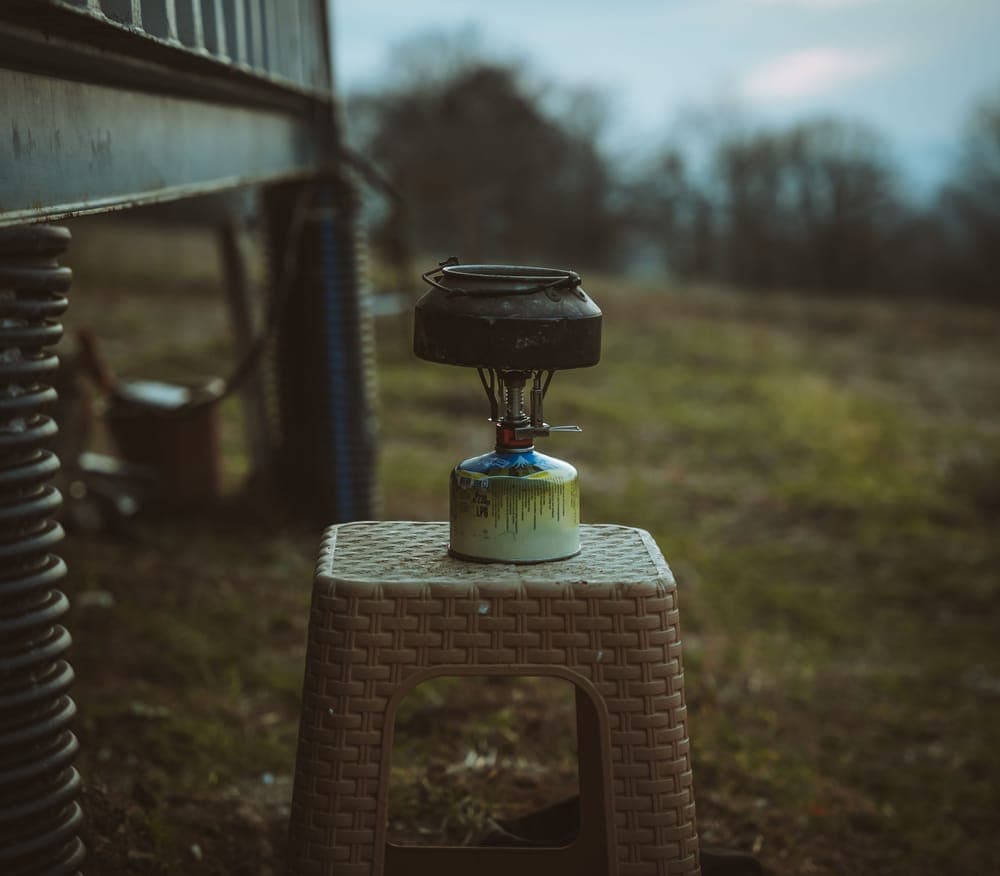
Isobutane-propane canisters are sold by their net fuel weight, and the two sizes our maker sources actually publish are a small canister around 100 to 110 g and a medium canister around 227 to 250 g (commonly labeled “4 oz” and “8 oz”). TOAKS states its 550 ml and 750 ml titanium pots each fit “a 110 g isobutane canister” inside, per the TOAKS 550 ml and 750 ml product pages, and MSR's Titan Kettle page states it holds “a 4 oz fuel canister plus a PocketRocket stove, or an 8 oz canister alone” ( MSR). MSR's own burn-time figures, below, are published for the 227 g (8 oz) size.
Larger canisters exist on store shelves for groups and base camps, but none of the stoves or pots in our Cook & Water hub catalog lists a specific weight or fit for one, so we won't guess at a number for it here. If you're provisioning for a group, weigh the specific canister you're buying rather than assume a round figure.
What drives how long a canister lasts
The number on a maker's spec sheet is a best-case figure. Four things push real-world consumption away from it, and the makers we cite say so in their own product copy.
- Wind. An open flame loses heat to moving air, so an unshielded stove burns longer, and more fuel, to hit the same boil. SOTO built the WindMaster around this: it states its Micro Regulator and burner design boil “2 cups of water in under 2-1/2 minutes in strong winds and gusty weather” (SOTO), a claim it doesn't make for calm conditions alone. A stove without that kind of wind design burns more fuel in the open than the spec sheet implies. See our best budget backpacking stoves roundup for which stoves publish a wind claim.
- Cold and low fuel. As a canister empties or gets cold, the liquid fuel inside loses pressure, and output drops. MSR built a pressure regulator into the PocketRocket Deluxe specifically to fight this: it states the regulator “maintains fast boil times in cold weather and with low fuel” (MSR), a feature the plain PocketRocket 2 doesn't have. The Deluxe weighs 83 g (2.9 oz), a gap of 10 g (0.4 oz) over the standard PocketRocket 2, for that regulator.
- Your pot. A heat-exchanger pot captures burner heat that would otherwise escape around the sides. Fire Maple states its Petrel G3's integrated heat exchanger “directs more burner heat into the pot for faster boiling and better fuel efficiency” ( Fire Maple), which is a maker claim, not a number we can verify, but the mechanism is real: less heat escaping means less fuel burned per boil.
- Altitude. None of the makers we cite publish altitude-adjusted burn times or boil times, so treat every figure on this page as a sea-level estimate.
How many boils per canister
MSR is the most specific maker in our catalog about this. It states the PocketRocket 2 burns for approximately 60 minutes and boils about 16 liters on a 227 g (8 oz) IsoPro canister, and it also gives a per-ounce rate: 2 liters boiled per 1 oz of fuel (MSR). The PocketRocket Deluxe is close behind: 60 minutes and 17 liters on the same 227 g canister.
SOTO reports a different unit entirely: it states the Amicus and the WindMaster both burn for approximately 1.5 hours on an 8 oz (250 g) canister (SOTO), but it doesn't say how many liters that boils. Since MSR reports liters and SOTO reports hours, you can't line the two up into a single “boils per canister” number without knowing each stove's own boil time per liter, which we won't invent. Read burn-time claims from different brands as separate data points, not a shared scale.
Picking the right canister size
For a solo weekend, the small (100 to 110 g) size is usually enough: at MSR's own boiling rate, that's roughly 7 to 8 liters, plenty for two or three days of boil-only meals for one person cooking once or twice a day. For longer trips or cooking for two, the 227 to 250 g size buys more margin, and MSR's 16-to-17-liter figure on that size covers considerably more boiling before you're guessing how much is left.
| Canister size | Liters boiled (MSR's rate) | Rough dinners covered (~350 mL each) | Fits best |
|---|---|---|---|
| Small, 100–110 g | About 7–8 L (our arithmetic on MSR's stated rate) | Roughly 20 dinners, ideal conditions | A solo weekend or a light spare |
| Medium, 227–250 g | 16–17 L (MSR's own published figure) | Roughly 45 dinners, ideal conditions | A solo week, or two people over a long weekend |
The dinners-covered column is arithmetic on MSR's own published liters figure, divided by a mid-range meal water requirement from our meals roundup. Treat it as a planning ceiling, not a promise: wind, cold, extra boils for coffee or dishwashing, and a pot without a heat exchanger will all use more fuel than the ideal-conditions math above.
Group trips multiply the math rather than change it: two people cooking the same meals roughly doubles the water boiled per night, which is the plainest reason to size up rather than pack two small canisters and hope one lasts. None of our sourced makers publish a canister size built specifically for groups, so budget by doubling the medium canister's figure above rather than guessing at a bigger size's numbers.
A canister isn't refillable, and you can't see how much fuel is left inside it. If I were judging a partly used canister before a trip, I'd weigh it on a kitchen scale and compare that to the empty canister weight printed on its own base, rather than shake it and guess. For a multi-day trip, carrying one full canister you're confident about beats stretching a used one you're not sure of.
What to buy
The two stoves below publish the clearest canister-consumption figures in our catalog, paired with a pot sized for the small canister.
Our picks for this
Stoves and a pot with published fuel figures
MSR and SOTO are the two makers in our catalog that publish burn-time and boil figures at all, and the TOAKS pot is sized for the small canister both stoves can run on.
Proven all-round canister stove
MSR PocketRocket 2
73 g (2.6 oz)$25–$50 band2.9 / 10MSR's own figures: about 60 minutes of burn time and 16 liters boiled per 227 g canister. The mainstream benchmark this whole guide's math is built on.
Check price · Amazon#ad · Price set by Amazon · Affiliate disclosure for the link to MSR PocketRocket 2
Budget canister stove with an igniter
SOTO Amicus Stove with Igniter
81 g (2.9 oz)$25–$50 band3.2 / 10SOTO states about 1.5 hours of burn time on an 8 oz (250 g) canister, plus a built-in igniter, at the same list price as the PocketRocket 2.
Check price · Amazon#ad · Price set by Amazon · Affiliate disclosure for the link to SOTO Amicus Stove with Igniter
Best solo titanium pot
TOAKS Titanium 750ml Pot (POT-750)
103 g (3.6 oz)$25–$50 band7.6 / 10TOAKS lists a 110 g canister and a PocketRocket 2 among what fits inside, so stove, pot and a small canister nest into one package.
Check price · Amazon#ad · Price set by Amazon · Affiliate disclosure for the link to TOAKS Titanium 750ml Pot (POT-750)
Photos are illustrative, not the product. Scores are spec-derived.
If you'd rather skip the canister question entirely, our canister vs alcohol stoves guide covers the alcohol-stove alternative, and BRS-3000T vs MSR PocketRocket 2 compares the lightest canister stove in our catalog against the mainstream benchmark used above. A titanium pot suited to a small canister, like the TOAKS 550 ml above (72 g (2.5 oz), lists at $25–$50 MSRP band), is ranked against the rest of the field in best titanium backpacking pots.
Mistakes to avoid
- Comparing MSR's liters to SOTO's hours as if they were the same measurement. They aren't, and neither maker converts between them.
- Assuming a spec-sheet burn time holds in wind or cold. MSR built a pressure regulator into the PocketRocket Deluxe specifically because the plain PocketRocket 2 doesn't hold up as well in cold weather or on a low canister.
- Packing only one canister for a group or a long trip. A canister isn't refillable mid-trip, and none of our sourced makers publish a large-canister figure to plan around.
- Guessing how much fuel is left by shaking the canister. Weigh it against the empty weight printed on its base instead.
- Ignoring your pot. Fire Maple's own heat-exchanger claim is that pot design changes fuel use, not just the stove.
- Picking a stove by weight alone. The BRS-3000T is the lightest canister stove in our stove roundup, but its maker publishes no fuel-consumption figure at all, so you can't compare its canister math to MSR's or SOTO's. A heavier stove with a published burn-time claim can be the easier one to plan fuel around.
For the rest of the kitchen, our best backpacking meals roundup covers what you're actually boiling water for, and if you want to skip fuel math entirely, see our cold soaking guide. Every number above comes from a maker's own product page, linked in the sources below, per our methodology.
How we scored this
Units we claim to have tested: 0
Most gear sites say they tested everything. We didn't, and we say so. What we did instead: took every weight and list price from the maker's own page, measured each product against a named mainstream reference, and computed grams saved per dollar. Every number links to where it came from.
The score is spec-derived: value and weight are computed from those numbers, and the rest are judgments from published specs, not test results. Commissions never set a score or decide a pick. The formula, weights and references are published.
Questions
Frequently asked
How long does a fuel canister last backpacking?
How long does a 4 oz fuel canister last?
What size fuel canister should I bring backpacking?
Does cold weather affect how long a fuel canister lasts?
Can you tell how much fuel is left in a canister?
Should I bring a spare fuel canister?
Receipts
Sources
- MSR (Cascade Designs): PocketRocket 2 Stove product page (checked 2026-09-22)
- MSR (Cascade Designs): PocketRocket Deluxe Stove product page (checked 2026-09-22)
- MSR (Cascade Designs): Titan Kettle 900mL product page (checked 2026-09-22)
- SOTO: Amicus Stove with Igniter product page (checked 2026-09-22)
- SOTO: WindMaster Stove with 4Flex product page (checked 2026-09-22)
- TOAKS: Ultralight Titanium 550ml Pot (POT-550-L) product page (checked 2026-09-22)
- TOAKS: Titanium 750ml Pot (POT-750) product page (checked 2026-09-22)
- Fire Maple: Petrel G3 600ml HX Pot product page (checked 2026-09-22)
We haven't tested the gear on this page and we don't pretend to. Weights, list prices and specs come from each maker's own pages (linked on every product), and performance figures such as boil times or flow rates are the maker's claims, labeled that way. Amazon sets its own prices and changes them often, so buy buttons link to the live listing. Where a figure isn't published, we say so. Read the full method.