The contenders
Side by side
 Illustrative photo
The one that saves weight
Osprey Exos 58
4.6 / 10A LightWire frame and a suspended mesh back at 1,320 g (S/M), with a removable lid. The load range stops at 35 lb, which is the whole catch.
Check price · Amazon#ad · Price as of November 3, 2026 · Affiliate disclosure for the link to Osprey Exos 58
 Illustrative photo
The one that carries weight
Osprey Atmos AG 65
4.0 / 10AntiGravity suspension, 65 L, a raincover in the box and a 30-40 lb range, for 772 g more than the Exos and no grams saved against our reference.
Check price · Amazon#ad · Price as of November 3, 2026 · Affiliate disclosure for the link to Osprey Atmos AG 65
The value alternative
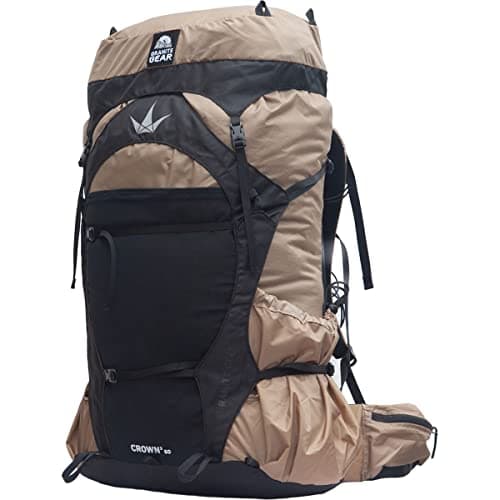
Granite Gear Crown3 60
5.2 / 1060 L at 1,080 g with a removable frame sheet and a 35 lb rating, in a lower price band than either Osprey. No suspended mesh back.
Check price · Amazon#ad · Price as of November 3, 2026 · Affiliate disclosure for the link to Granite Gear Crown3 60
These are the two Osprey packs most people end up choosing between, and the internet usually frames the choice as ultralight against traditional. That is not quite right. The Exos is not an ultralight pack; at 1,320 g (2 lb 14.6 oz) it is the heaviest pack in our ultralight class and heavier than several frameless packs by half a kilogram. What it is, is Osprey's lightweight pack: a real frame, a ventilated back, and about two pounds less than the Atmos.
So the question is not which pack is better. It is whether your gear fits inside the lighter one's load limit. Everything else on this page is detail.
Side by side
| Published spec | Osprey Exos 58 | Osprey Atmos AG 65 | Granite Gear Crown3 60 |
|---|---|---|---|
| Weight | 1,320 g (2 lb 14.6 oz) | 2,092 g (4 lb 9.8 oz) | 1,080 g (2 lb 6.1 oz) |
| List price | $200–$300 band | $300–$400 band | $200–$300 band |
| Value | Value 1.3/10 | No grams saved vs the reference | Value 2.3/10 |
| Capacity | 58 L (S/M), 61 L (L/XL) | 65 L (S/M), 68 L (L/XL) | 60 L (3,660 cu in), all torso sizes |
| Frame | 4 mm powder-coated LightWire frame; AirSpeed suspended mesh back panel with 4 in of torso adjustment | 4 mm powder-coated full peripheral frame; AntiGravity suspension; cam-lock torso adjustment | Removable Vapor Current Mark 3 PE frame sheet with molded foam back panel |
| Max load | 30-35 lb (14-16 kg) | 30-40 lb (14-18 kg) | 25 lb without frame sheet, 35 lb with it, 43 lb with the optional aluminum stay (sold separately) |
| Score | 4.6 / 10 | 4.0 / 10 | 5.2 / 10 |
The load range is the real decision
Osprey publishes a recommended load range for both packs: 30-35 lb (14-16 kg) for the Exos 58 and 30-40 lb (14-18 kg) for the Atmos AG 65 (Osprey). Five pounds does not sound like much until you work out what is in it.
Add up a typical three-day load: base weight, three days of food at roughly 1.5 to 2 lb a day, and two liters of water at about 4.4 lb. If your base weight is 20 lb, you are at 30 lb or so on day one and inside the Exos's range. If your base weight is 28 lb — which is normal for someone who has not yet replaced a heavy tent and a heavy bag — you are at 38 lb on day one, above the Exos's published ceiling and inside the Atmos's.
Over the ceiling, a lightweight frame does not fail dramatically. It just stops transferring the load cleanly, and the weight ends up on your shoulders. The fix is not a bigger pack; it is a lighter kit. Work out where you actually are first with what base weight means, then use how heavy your backpack should be to check the total against both ranges.
LightWire against AntiGravity
Both packs suspend a mesh panel off your back so air can move behind it, and the two systems are not the same thing.
- Exos 58, AirSpeed. A 4 mm powder-coated LightWire perimeter frame with a suspended mesh back panel and 4 in of torso adjustment. The hipbelt is a conventional padded belt with two zippered pockets.
- Atmos AG 65, AntiGravity. A 4 mm full peripheral frame with the suspended mesh running continuously from the back panel into the hipbelt, plus cam-lock torso adjustment (Osprey).
The practical difference is where the mesh wraps. On the Atmos it continues around your hips, which is what makes the pack feel like it is holding you rather than sitting on you under a heavy load. That mesh, the heavier frame and the thicker belt are most of the 772 g (1 lb 11.2 oz) between the two packs.
Both packs come under Osprey's All Mighty Guarantee, which Osprey describes as repairing any damage or defect for any reason, or replacing the pack. That is worth saying plainly, because it is the same on both and it is a real part of what you are paying either price for.
58 L or 65 L, and what that really means
Osprey lists 58 L for the Exos S/M and 61 L for the L/XL; 65 L for the Atmos S/M and 68 L for the L/XL. Seven liters is roughly a bear canister, or a winter sleeping bag instead of a summer quilt, or the difference between a four-day food carry and a seven-day one.
The trap is buying volume you then fill. A 65 L pack with a lightweight kit inside it is a half-empty bag that sags and swings; a 58 L pack stuffed past its load rating carries badly. Size the pack to the kit you own today, not the kit you hope to own. Our guide to backpack volume works through the trip lengths, and the sizing guide covers torso length, which matters more than either number here: the Exos S/M fits a 17-20.5 in torso, the L/XL 19.5-23 in.
Fabric, pockets and the raincover
| Exos 58 | Atmos AG 65 | |
|---|---|---|
| Main fabric | Recycled 100D high-tenacity nylon ripstop | Recycled 210D honeycomb nylon |
| Reinforcement | Recycled 400D high-tenacity nylon | Recycled 500D high-tenacity nylon bottom |
| Lid | Removable floating lid with FlapJacket | Floating lid |
| Front and side pockets | Stretch mesh front, dual-access side pockets | Two zippered front pockets, side zip access |
| Raincover | Not included | Included |
| Warranty | All Mighty Guarantee | All Mighty Guarantee |
Two details are worth pulling out. The Exos's lid comes off, and the built-in FlapJacket closes the top without it — Osprey's own way of letting you shave grams off a pack you already bought, which not many makers offer. And the Atmos includes a raincover, which on the Exos is a separate purchase or a trash-compactor bag, the cheaper and lighter answer either way.
On durability, the Atmos's 210D body against the Exos's 100D is the clearest material difference on the page. Thin pack fabric survives trail use fine and abrades faster when you set the pack down on granite twice a day for a month.
Value: one of these two saves no grams at all
Here is where our math says something the brand pages will not. Both packs are measured against the Osprey Rook 65, our entry-level framed reference at 1,678 g (3 lb 11.2 oz).
That is not a knock on the Atmos as a pack. It is a statement about what it is for. The Atmos is a comfort-first pack built to carry loads that a lighter frame cannot, and if you need that, grams per dollar is the wrong metric to shop by — the Rook 65 reference is also a fine pack and also saves nothing. But if you came to this comparison hoping the Atmos was the sensible all-rounder and the Exos the extravagance, the numbers say the opposite.
The pack that beats both on value
If the suspended mesh back is not the feature you care most about, the Granite Gear Crown3 60 undercuts both Ospreys on weight and price: 60 L at 1,080 g (2 lb 6.1 oz), a removable frame sheet, and a 35 lb load rating that rises to 43 lb with an optional aluminum stay (Granite Gear). It saves 598 g (1 lb 5.1 oz) vs the Osprey Rook 65, scores Value 2.3/10 on value, and carries a lifetime warranty against defects.
What it does not have is a ventilated back — the Crown3 uses a molded foam panel against your spine, so your shirt gets wetter. That is the trade, and it is the same trade the whole category makes. We run the Crown3 against the Exos directly in Granite Gear Crown3 60 vs Osprey Exos 58, and the Exos against a cottage ultralight pack in Osprey Exos vs Durston Kakwa 55.
Who should buy which
| If you | Buy |
|---|---|
| Carry under about 35 lb loaded | Exos 58 |
| Carry 35-40 lb, or a bear canister plus a week of food | Atmos AG 65 |
| Want the lightest of the two with a real frame | Exos 58 |
| Have had hip or shoulder trouble under load | Atmos AG 65 |
| Want a raincover in the box | Atmos AG 65 |
| Want the best grams per dollar of the three | Granite Gear Crown3 60 |
| Have a torso under 17 in | Neither in S/M; check the women's Eja and Aura fits |
Both Ospreys appear in our wider pack rankings: the budget ultralight packs for the Exos, and the men's-fit pack ranking for the Atmos. If the Exos's load ceiling is your sticking point, the honest fix is upstream: a lighter shelter. Our freestanding tent ranking is where most people find the first kilogram.
What we cannot tell you
We do not carry these packs, so we cannot tell you how either one feels on your hips at mile 14. Fit is the single biggest variable in pack comfort and it is specific to your torso, your shoulders and your load, which is why both of these packs have devoted fans who will tell you the other one is unbearable.
What we can do is be precise about the published numbers: 1,320 g against 2,092 g, 58 L against 65 L, a 35 lb ceiling against a 40 lb one, 100D fabric against 210D. Osprey's own pages disagree with its owner's manual about the Exos's weight by 32 g, and we use the heavier figure throughout. Try both on loaded, in a shop, if you possibly can — and read the Exos owner's manual for the torso ranges before you order either online.
In detail
The contenders, in full
Illustrative photoThe one that saves weight
Osprey Exos 58
A LightWire frame and a suspended mesh back at 1,320 g (S/M), with a removable lid. The load range stops at 35 lb, which is the whole catch.
Published specsFrom the maker, with the source linked
| Weight | 1,320 g (2 lb 14.6 oz) (listed weight, S/M (1.32 kg in the S22 owner's manual; the product page lists 1.288 kg, heavier figure used)) |
|---|---|
| List price | $200–$300 MSRP band (per osprey.com, checked Sep 2026) |
| Value | Value 1.3/10vs the reference Osprey Rook 65 at 1,678 g (3 lb 11.2 oz) |
| Volume | 58 L (S/M), 61 L (L/XL) |
| Weight (S/M) | 1,288 g on the product page; 1,320 g in the S22 owner's manual (L/XL: 1,334 g vs 1,360 g) |
| Load range | 30-35 lb (14-16 kg) |
| Frame | 4 mm powder-coated LightWire frame; AirSpeed suspended mesh back panel with 4 in of torso adjustment |
| Torso sizes | S/M 17-20.5 in (43-52 cm), L/XL 19.5-23 in (49-58.9 cm) |
| Fabric | Recycled 100D high-tenacity nylon ripstop main; recycled 400D high-tenacity nylon also listed |
| Pockets | Dual zippered hipbelt pockets, removable floating lid, front stretch mesh pocket, dual-access side pockets; internal hydration sleeve |
| Warranty | All Mighty Guarantee: Osprey repairs any damage or defect for any reason, or replaces the pack |
How the 4.6 score breaks down
- Grams per dollar (35%, computed)
- 1.3
- Weight (20%, computed)
- 2.9
- Carry, capacity & load (25%)
- 8.0
- Materials & durability (10%)
- 8.0
- Ease & versatility (10%)
- 8.0
What the specs support
- Suspended mesh back panel on a LightWire frame
- Removable lid and built-in FlapJacket let you trim it down
- Osprey's guarantee covers damage for any reason, not just defects
Where it falls short
- 1,320 g (S/M) is the heaviest of the ultralight-class picks here
- 30-35 lb load range sits below the Kakwa 55's 45 lb max
- Osprey's own pages disagree on the weight by 32 g
Skip it if…
Skip it if your torso is under 17 in: the Exos S/M starts there (Osprey lists the women's Eja down to 13.5 in).
#ad · Price as of November 3, 2026 · Affiliate disclosure for the link to Osprey Exos 58
Illustrative photoThe one that carries weight
Osprey Atmos AG 65
AntiGravity suspension, 65 L, a raincover in the box and a 30-40 lb range, for 772 g more than the Exos and no grams saved against our reference.
Published specsFrom the maker, with the source linked
| Weight | 2,092 g (4 lb 9.8 oz) (listed weight, S/M (4.613 lb / 2.092 kg)) |
|---|---|
| List price | $300–$400 MSRP band (per osprey.com, checked Sep 2026) |
| Value | No grams saved vs the referencevs the reference Osprey Rook 65 at 1,678 g (3 lb 11.2 oz) |
| Volume | 65 L (S/M), 68 L (L/XL) |
| Weight by size | S/M 2.092 kg, L/XL 2.18 kg |
| Load range | 30-40 lb (14-18 kg) |
| Frame | 4 mm powder-coated full peripheral frame; AntiGravity suspension; cam-lock torso adjustment |
| Fabric | Recycled 210D honeycomb nylon main; recycled 500D high-tenacity nylon bottom |
| Pockets | Dual zippered hipbelt pockets, floating lid, two zippered front pockets, side zip access; hydration sleeve; raincover included |
| Warranty | All Mighty Guarantee: Osprey repairs any damage or defect for any reason, or replaces the pack |
How the 4.0 score breaks down
- Grams per dollar (35%, computed)
- 0.0
- Weight (20%, computed)
- 0.0
- Carry, capacity & load (25%)
- 9.0
- Materials & durability (10%)
- 8.5
- Ease & versatility (10%)
- 8.5
What the specs support
- AntiGravity suspended-mesh back and hipbelt
- 30-40 lb load range with dual hipbelt pockets and side zip access
- Raincover included; any-reason repair guarantee
Where it falls short
- 2,092 g (S/M): heavier than the Rook 65 reference, so zero grams saved
- Highest list price of any pack here
Skip it if…
Skip it if a lighter base weight is the goal: at 2,092 g (S/M) it outweighs the Rook 65 reference by more than 400 g.
#ad · Price as of November 3, 2026 · Affiliate disclosure for the link to Osprey Atmos AG 65
The value alternative
Granite Gear Crown3 60
60 L at 1,080 g with a removable frame sheet and a 35 lb rating, in a lower price band than either Osprey. No suspended mesh back.
Published specsFrom the maker, with the source linked
| Weight | 1,080 g (2 lb 6.1 oz) (listed weight, Regular torso, without the removable lid (lid listed at 0.18 lb)) |
|---|---|
| List price | $200–$300 MSRP band (per granitegear.com, checked Sep 2026) |
| Value | Value 2.3/10vs the reference Osprey Rook 65 at 1,678 g (3 lb 11.2 oz) |
| Volume | 60 L (3,660 cu in), all torso sizes |
| Weight by size | Short 1.04 kg, Regular 1.08 kg, Long 1.13 kg, without lid; lid 0.18 lb; 2 lb with the frame sheet removed |
| Frame | Removable Vapor Current Mark 3 PE frame sheet with molded foam back panel |
| Load rating | 25 lb without frame sheet, 35 lb with it, 43 lb with the optional aluminum stay (sold separately) |
| Fit | Fixed torso in 3 sizes: Short 15-18 in, Regular 18-21 in, Long 21-24 in; Re-Fit belt 26-42 in |
| Fabric | Robic high-tenacity nylon, 100D and 210D, Barrier DWR |
| Pockets | Lid compartments, 1 stretch pocket, 2 cinchable side pockets, 2 hipbelt pockets; hydration port and sleeve |
| Warranty | Lifetime, against defects in materials or workmanship |
How the 5.2 score breaks down
- Grams per dollar (35%, computed)
- 2.3
- Weight (20%, computed)
- 4.9
- Carry, capacity & load (25%)
- 7.5
- Materials & durability (10%)
- 7.5
- Ease & versatility (10%)
- 8.0
What the specs support
- Frame sheet, lid and optional stay let one pack cover 25 lb to 43 lb loads
- Three torso sizes and an adjustable Re-Fit hipbelt
- Lifetime warranty on Robic fabric
Where it falls short
- The listed weight excludes the 0.18 lb lid
- Torso length is fixed per size, so you must pick the right one
- Heavier than every frameless pick here
Skip it if…
Skip it if your torso measures between sizes and you want to fine-tune it: Granite Gear lists the Crown3 torso as fixed and non-adjustable in each of its three sizes.
#ad · Price as of November 3, 2026 · Affiliate disclosure for the link to Granite Gear Crown3 60
How we scored this
How these picks were chosen
Every weight and list price here comes straight from the maker's own product page, measured against a named mainstream reference, then turned into one number: grams saved per dollar. Every figure links to the page it came from, so you can check any of it in a click.
Value and weight are computed from those published numbers; function, durability and ease are scored from the specs, manuals and standards each maker publishes. Commissions never set a score or decide a pick. The formula, weights and references are published.
What changed
- Published.
Questions
Frequently asked
Is the Osprey Exos 58 or the Atmos AG 65 better?
How much heavier is the Atmos AG 65 than the Exos 58?
Can the Exos 58 carry 40 lb?
Does the Exos 58 come with a raincover?
Is there a lighter pack than the Exos 58 with a frame?
Receipts
Sources
- Osprey: Exos 58 product page, Specifications (checked 2026-09-22)
- Osprey: Exos/Eja series owner's manual, S22 (PDF, checked 2026-09-22)
- Osprey: Atmos AG 65 product page, Specifications (checked 2026-09-22)
- Osprey: Rook 65L product page, the pack reference (checked 2026-09-22)
- Granite Gear: Crown3 60 Unisex product page (checked 2026-09-22)
Weights, list prices and specs on this page come from each maker's own pages, linked on every product, and performance figures such as boil times or flow rates are the maker's claims, labeled that way, so you always know whose number you're reading. Amazon sets its own prices and changes them often, so buy buttons link to the live listing. Read the full method.