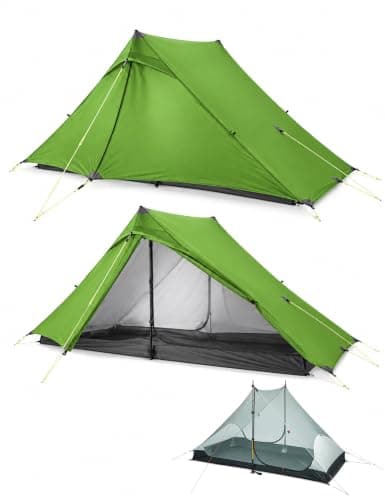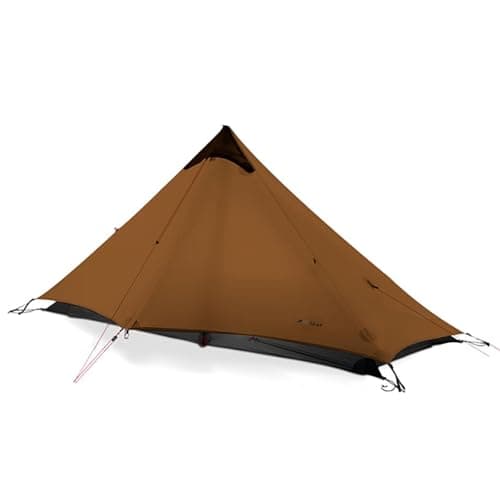
Most tent-buying advice starts with weight, which is why people end up either carrying a four-pound tent they resent or sleeping in a nine-hundred-gram shelter they do not know how to pitch. Weight is a consequence of four earlier decisions, not the first one. Make those four in order and the field collapses from several hundred tents to about six.
The order that narrows the field
Capacity, pitch type, wall count, fabric. Each answer removes most of what is left. Only then is it worth comparing grams, because at that point you are comparing tents that would actually work for you rather than a Dyneema pyramid against a freestanding dome with a 68D floor.
1. Capacity: buy one size up
Tent capacity ratings describe shoulder-to-shoulder sleeping capacity with no gear, and no maker pretends otherwise once you read the floor dimensions. A two-person tent is usually around 50 inches wide, which is two 25 in pads touching with nowhere to put a pack. A solo hiker who wants to keep gear inside, roll over without hitting mesh, or sit out a rainy afternoon should be looking at two-person tents.
Two people sharing every night should look at two-person tents with two doors, or at three-person tents if either of you is tall. The jump from one door to two is the biggest liveability upgrade in a tent, and it costs very little weight. Our two-person ranking and three-person ranking both sort the field on published floor area for exactly this reason.
2. Freestanding or trekking-pole
This decision changes which half of the market you shop in, and it comes down to one question: do you already carry trekking poles?
| Question | Freestanding | Trekking-pole |
|---|---|---|
| Carries its own poles | Yes, usually 300-500 g of them | No, it uses poles you already hold |
| Pitches on rock, platforms, sand | Yes, stand it up and weight the corners | Needs stakes or heavy rocks to hold |
| Typical minimum weight for 2P | About 1,200-1,900 g | About 1,000-1,200 g |
| Learning curve | Clip it to the poles and you are done | Real: a bad first pitch sags and flaps |
If you hike with poles, a trekking-pole tent is the cheapest weight saving available anywhere in your kit, because you delete the pole set entirely. If you do not, buy freestanding and do not feel bad about it. The full argument is in trekking-pole tent vs freestanding tent.
3. Single wall or double wall
A double-wall tent has a separate mesh inner and a waterproof fly, so condensation forms on the fly and drips outside your sleeping bag. A single-wall tent is one layer, so condensation forms on the inside of the thing you are touching. Single wall saves roughly 100-300 g and a fair amount of money.
One detail catches people out: several budget single-wall shelters are not seam-sealed from the factory. 3F UL Gear says plainly that the Lanshan Pro models need sealing with silicone sealant before use. That is an evening of work and a tube of sealant, and it is not optional. See single wall vs double wall.
4. The fabric rows that matter
Three numbers, and the makers publish all three.
- Denier (D) is thread thickness. The Kelty Late Start 2P uses 68D polyester for fly and floor; budget ultralight tents use 15D or 20D. A 68D floor survives a gritty campsite without a footprint; a 15D fly is a tent you pitch carefully.
- Hydrostatic head (mm) is how much water pressure the coating resists. Kelty lists 1200 mm on the Late Start 2P, Big Agnes 1500 mm on the Copper Spur UL2, Naturehike PU 3000 mm+ on the Cloud Up Pro 2 and 3F UL Gear 5,000 mm on the Lanshan 2 fly. Higher is not automatically better: coating thickness adds weight, and a well-pitched 1500 mm fly outperforms a saggy 5000 mm one.
- Silicone or PU. Silicone-coated nylon is lighter and stronger but stretches when wet, so you re-tension in the night. PU-coated fabric holds its shape and is easier to seam-tape. Detail in silnylon vs silpoly vs Dyneema.
5. Floor area, doors and vestibules
Floor area is the honest liveability number, and every mainstream maker prints it. Kelty lists 30.6 sq ft on the Late Start 2P; Big Agnes lists 29 sq ft on the Copper Spur UL2 but splits the outside into two 9 sq ft vestibules with two side doors, which is why the smaller-floored tent feels bigger.
Vestibule area is where your pack and boots live. A tent with 7 sq ft of vestibule and one door means one of you crawls over the other at 2 a.m. and both packs share one porch. If you compare only one liveability spec between two tents, compare doors.
6. What weight is realistic
Read the minimum or trail weight (body, fly, poles) and the packed weight separately, because makers quote whichever flatters them. Kelty lists 4 lbs 5 oz minimum and 4 lbs 12 oz packaged for the same tent. Naturehike lists the Cloud Up Pro 2 at about 1.36 kg minimum and 1.53 kg packaged. What you carry is closer to the second figure.
Realistic targets for a two-person tent: under 1,900 g is mainstream, under 1,400 g is light, under 1,100 g is ultralight and usually means trekking poles. Our tent weight guide works through the per-person arithmetic.
Four tents that show the spread
Not a ranking: four tents chosen to show what each decision costs. Every weight and spec below is the maker's own published figure, linked in the sources.
Our picks for this
One tent per decision
A double-wall trekking-pole tent, a budget freestanding dome, the mainstream baseline and the premium benchmark. The point is the spread between them, not the order.
Budget double-wall trekking-pole tent for 2
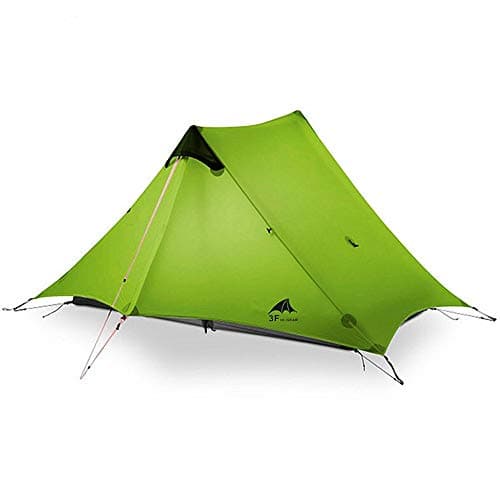
3F UL Gear Lanshan 2
1,060 g (2 lb 5.4 oz)$150–$200 band7.0 / 10The cheap way to own a two-door double wall: factory-taped seams, 1,060 g, and you supply the poles you already carry.
$187.88Amazon#ad · Price as of November 3, 2026 · Affiliate disclosure for the link to 3F UL Gear Lanshan 2
Current budget 2P freestanding pick
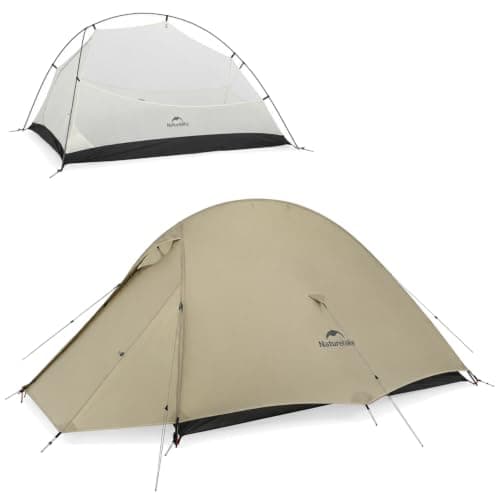
Naturehike Cloud Up Pro 2
1,360 g (2 lb 16.0 oz)$150–$200 band5.5 / 10Freestanding, footprint in the box, 130 cm wide inner. Naturehike publishes no door or vestibule count for it, which is itself worth knowing.
$139.99Amazon#ad · Price as of November 3, 2026 · Affiliate disclosure for the link to Naturehike Cloud Up Pro 2
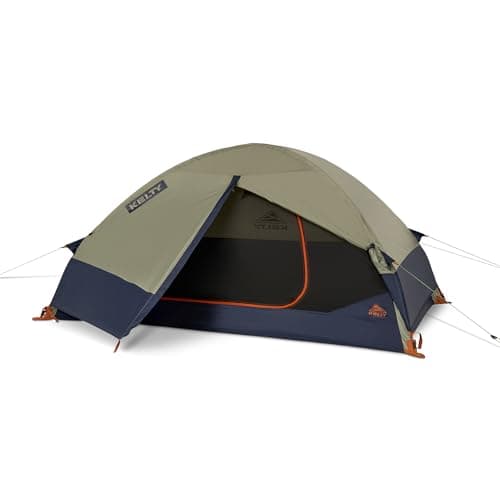
Mainstream 2P baseline (the reference)
Kelty Late Start 2P
1,900 g (4 lb 3.0 oz)$150–$200 band3.2 / 10The mainstream baseline: 68D fabric, the largest floor here at 30.6 sq ft, and 1,900 g to carry for it.
$159.95Amazon#ad · Price as of November 3, 2026 · Affiliate disclosure for the link to Kelty Late Start 2P
Premium freestanding 2P benchmark
Big Agnes Copper Spur UL2
1,180 g (2 lb 9.6 oz)$500–$700 band5.2 / 10What the money buys: two doors, two 9 sq ft vestibules, DAC poles and 1,180 g. The benchmark everything else is measured against.
Check price · Amazon#ad · Price as of November 3, 2026 · Affiliate disclosure for the link to Big Agnes Copper Spur UL2
Photos are illustrative, not the product. Scores are spec-derived.
The three expensive mistakes
Buying for the worst night of your life. A four-season tent is heavier, hotter and dearer, and almost nobody who buys one camps in winter. Buy for the trips you actually take and borrow for the outlier.
Buying a one-person tent to save grams. The weight gap between a good 1P and a good 2P is often under 300 g, and the liveability gap is enormous. See the solo ranking if you are sure.
Forgetting the footprint in the price. Kelty and Big Agnes sell theirs separately; Naturehike includes one. That is a real difference in what you pay, and you may not need one at all.
How we scored this
How these picks were chosen
Every weight and list price here comes straight from the maker's own product page, measured against a named mainstream reference, then turned into one number: grams saved per dollar. Every figure links to the page it came from, so you can check any of it in a click.
Value and weight are computed from those published numbers; function, durability and ease are scored from the specs, manuals and standards each maker publishes. Commissions never set a score or decide a pick. The formula, weights and references are published.
What changed
- Published.
Questions
Frequently asked
What size backpacking tent should one person buy?
Is a trekking-pole tent harder to pitch?
How many millimetres of waterproofing does a tent fly need?
Do I need to seam-seal a new backpacking tent?
Receipts
Sources
- 3F UL Gear: Lanshan 2 product page (checked 2026-09-22)
- Naturehike: Cloud Up Pro 2-Person tent product page (checked 2026-09-22)
- Kelty: Late Start 2P Tent product page (checked 2026-09-22)
- Big Agnes: Copper Spur UL2 product page and spec table (checked 2026-09-22)
Weights, list prices and specs on this page come from each maker's own pages, linked on every product, and performance figures such as boil times or flow rates are the maker's claims, labeled that way, so you always know whose number you're reading. Amazon sets its own prices and changes them often, so buy buttons link to the live listing. Read the full method.