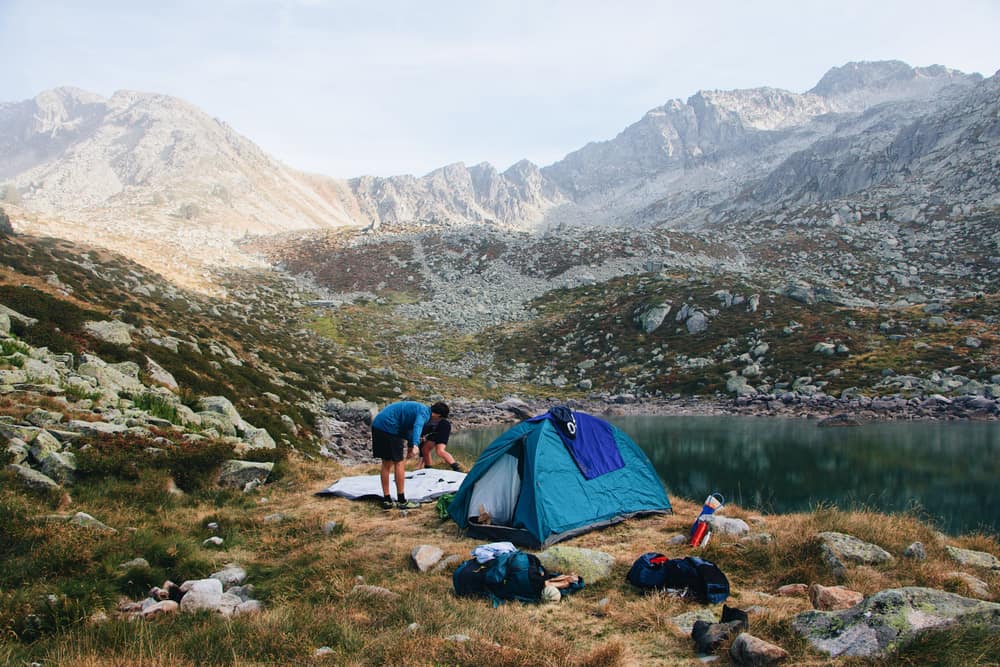
A tent footprint is a thin sheet you pitch under the tent floor, between the fabric and the ground. It isn't part of the shelter itself, which is why every tent on this site ships without one unless the maker says otherwise, and it isn't required to pitch a tent safely. Whether it's worth the extra weight and price comes down to two things: what your tent's floor is made of, and what you usually pitch it on.
What a footprint actually protects
A tent floor takes abrasion from below every time you pitch it: sharp gravel, roots, pine cones and grit working under body weight all night. A footprint takes that wear instead of the tent's own floor, which matters more on some tents than others. Floor fabric varies a lot across the tents in our tent roundups, and the published specs make the pattern clear:
| Tent | Floor fabric | Waterproof rating |
|---|---|---|
| Kelty Late Start 2P (this site's reference) | 68D polyester | 1,200 mm |
| Naturehike Cloud Up 2 | 20D silicone-coated nylon | PU 4,000 mm+ |
| 3F UL Gear Lanshan 2 | 15D PU nylon | 6,000 mm |
| Durston X-Mid 2 | 15D Sil/PE nylon | 3,500 mm |
| Zpacks Duplex | Dyneema composite fabric (DCF) | Not published in mm |
Two things stand out. First, a higher denier number (the “68D” or “15D”) means a thicker, more abrasion-resistant thread, which is a separate spec from the waterproof rating in millimeters; a thin 15D floor can still carry a very high mm rating and still puncture more easily than a heavier 68D floor rated lower. Second, Dyneema composite fabric doesn't use the same mm hydrostatic-head rating at all, so a Duplex owner is trusting the maker's fabric choice rather than a published number.
When you need one
- Your tent's floor is a thin denier fabric. Most budget ultralight tents, including every trekking-pole tent in our best trekking-pole tents roundup, use 15D or 20D floors to save weight. That thinner fabric is more likely to puncture on sharp ground than a heavier 68D floor.
- You camp on rock, gravel, sand or pine duff. Established dirt or grass campsites are gentle on a tent floor. Rocky ridgelines, sandy desert sites and thick pine duff hide sharp debris under the surface, which is exactly what a footprint is built to take instead of the tent.
- You want a Fast Fly pitch. Some fitted footprints, like the Big Agnes Copper Spur UL2's, buckle to the tent's own pole corners so you can pitch the fly and footprint alone, no mesh inner, for a lighter, faster setup on a clear night.
- You pitch on a wooden tent platform. Backcountry sites with raised wooden platforms are rough on any floor fabric; a footprint (or a folded groundsheet) is cheap insurance there.
When you can skip it
- Your tent already has a heavier floor. Kelty Late Start 2P and other mainstream 68D-polyester tents are built to take more abuse bare.
- You mostly camp on maintained sites. Cleared, soft dirt or grass campsites in established campgrounds rarely puncture a tent floor.
- The weight and price genuinely don't pay for themselves. A fitted footprint can add real grams and dollars for a tent you only pitch on soft ground a few nights a year.
What this means for your budget: if you're carrying a thin-floor trekking-pole tent and you camp anywhere rocky or sandy, a footprint is one of the cheapest upgrades in this site's entire catalog. If your tent already has a heavier floor and you stick to established sites, the weight is better spent elsewhere.
A fitted footprint vs a trimmed polycro sheet
Once you've decided you want one, the choice is between a footprint cut and buckled for your exact tent model, and a plain sheet of polycro film you trim to size yourself.
A fitted footprint, like Kelty Late Start 2P Footprint, matches the tent's corners exactly and, on some tents, unlocks a Fast Fly pitch. It also costs more and weighs more: Kelty Late Start 2P Footprint weighs 198 g (7.0 oz) and is cut from the same 68D polyester as the reference tent's own floor. The Big Agnes Copper Spur UL2 Footprint is lighter, at 148 g (5.2 oz), but it fits only that model and its list price is the highest of the three footprints in our catalog. Big Agnes cuts it from a 30D nylon, heavier than the Copper Spur UL2's own 15D/20D floor fabric but still lighter than the Kelty footprint's 68D polyester, which is how it stays fitted without weighing as much as a mainstream-tent footprint.
A polycro sheet, like the Six Moon Designs 2-pack, is a thin plastic film rather than a woven fabric. It weighs far less, 53 g (1.9 oz) for a large sheet, and lists at Under $25 MSRP band, with a second sheet in the pack as a spare. Its value figure works out to Value 10.0/10 against the fitted Kelty footprint. The trade is that you trim it to fit yourself, it has no tent-specific corners, and it won't hold up to sharp rock the way a woven fabric does over many trips.
Which one to buy
If your tent has factory buckles for a fitted footprint and you want the Fast Fly option, buy the fitted one made for your model. If you just want floor protection at the lowest weight and price, a polycro sheet trimmed to fit almost any tent does the job for less. Either way, weigh the addition against the rest of your kit: a footprint is real, useful weight, not the kind you cut for its own sake. See how to lower your base weight for where it ranks against your other upgrades.
Our picks for this
The three footprints in our catalog
One fitted footprint for a mainstream 68D tent, one budget polycro sheet that fits almost anything, and one fitted footprint built specifically for a premium freestanding tent's Fast Fly pitch.
Fitted footprint baseline (the reference)
Kelty Late Start 2P Footprint
198 g (7.0 oz)$25–$50 band3.6 / 10Fitted to the Kelty Late Start 2P's exact floor in the same 68D polyester as the tent. The heaviest of the three, but nothing to trim or guess at.
Check price · Amazon#ad · Price set by Amazon · Affiliate disclosure for the link to Kelty Late Start 2P Footprint
Lightest, cheapest ground sheet
Six Moon Designs Polycro Footprint (Large, 2-pack)
53 g (1.9 oz)Under $25 band7.8 / 10The lightest, cheapest way to protect almost any tent's floor. Trim it to size yourself; it has no tent-specific corners and won't survive sharp rock as long as a woven fabric.
Check price · Amazon#ad · Price set by Amazon · Affiliate disclosure for the link to Six Moon Designs Polycro Footprint (Large, 2-pack)
Fitted footprint with Fast Fly pitch
Big Agnes Copper Spur UL2 Footprint
148 g (5.2 oz)$50–$100 band4.7 / 10Built only for the Copper Spur UL2, with buckles that match its pole corners for a Fast Fly, no-inner pitch. Skip it if you don't own that tent.
Check price · Amazon#ad · Price set by Amazon · Affiliate disclosure for the link to Big Agnes Copper Spur UL2 Footprint
Photos are illustrative, not the product. Scores are spec-derived.
Whichever you choose, a footprint always goes under the tent, between the floor and the ground, never inside. For how floor fabric fits into the bigger weight-and-price picture, see silnylon vs silpoly vs Dyneema, and for how much a whole tent should weigh before you add a footprint, see how much should a backpacking tent weigh.
How we scored this
Units we claim to have tested: 0
Most gear sites say they tested everything. We didn't, and we say so. What we did instead: took every weight and list price from the maker's own page, measured each product against a named mainstream reference, and computed grams saved per dollar. Every number links to where it came from.
The score is spec-derived: value and weight are computed from those numbers, and the rest are judgments from published specs, not test results. Commissions never set a score or decide a pick. The formula, weights and references are published.
What changed
- Published.
Questions
Frequently asked
Do I need a footprint under my tent?
What can I use instead of a tent footprint?
Does a footprint go under or inside the tent?
Will a footprint make my tent waterproof?
Should a footprint be bigger or smaller than my tent?
Is a polycro ground sheet worth it?
Receipts
Sources
- Kelty: Late Start 2P Footprint product page, this site's footprint reference (checked 2026-09-22)
- Six Moon Designs: Ultralight Shelter Footprint (Polycro / Tyvek) product page (checked 2026-09-22)
- Big Agnes: Copper Spur UL2 Footprint product page and spec table (checked 2026-09-22)
- Kelty: Late Start 2P Tent product page, floor fabric reference (checked 2026-09-22)
- Naturehike: Cloud Up 2-Person product page, floor fabric reference (checked 2026-09-22)
- 3F UL Gear: Lanshan 2 product page, floor fabric reference (checked 2026-09-22)
- Durston Gear: X-Mid 2 product page, floor fabric reference (checked 2026-09-22)
- Zpacks: Duplex Classic Tent product page, floor fabric reference (checked 2026-09-22)
We haven't tested the gear on this page and we don't pretend to. Weights, list prices and specs come from each maker's own pages (linked on every product), and performance figures such as boil times or flow rates are the maker's claims, labeled that way. Amazon sets its own prices and changes them often, so buy buttons link to the live listing. Where a figure isn't published, we say so. Read the full method.