“Backpacking sleeping bag” is a marketing phrase, not a weight class. The same shelf holds a 550 g quilt and a 1.6 kg mummy bag with the same number printed on the label. Since the bag is usually the second or third heaviest item in a pack, getting the target right is one of the biggest single wins available to a kit.
The target weights
| Rating | Down, good | Down, excellent | Synthetic, good |
|---|---|---|---|
| 40°F | Under 700 g | Under 500 g | Under 1,000 g |
| 30°F | 700-900 g | Under 700 g | 1,000-1,300 g |
| 20°F | 900-1,150 g | Under 900 g | 1,300-1,600 g |
| 15°F | 1,000-1,250 g | Under 1,000 g | 1,500-1,800 g |
These are targets built from the published weights of the bags and quilts we track, not from a standard. The reference this site measures cold-rated insulation against is the Kelty Cosmic Synthetic 20 at 1,276 g (2 lb 13.0 oz) — a synthetic mainstream 20°F bag — which is roughly where the mass market sits.
What actually drives the number
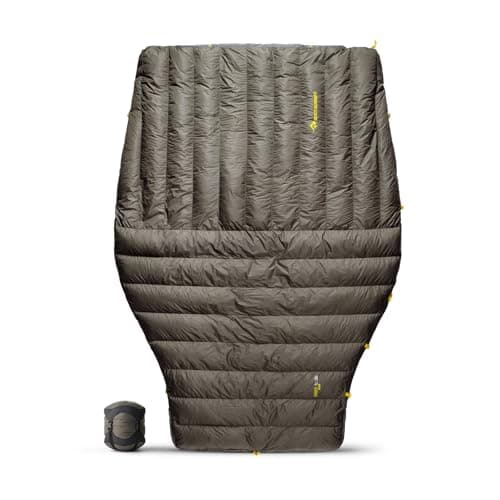
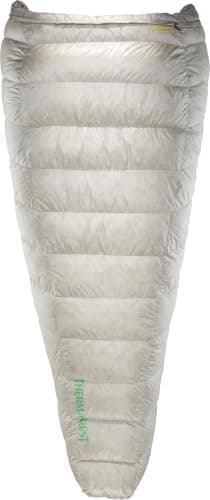
That last point is why the lightest options are quilts: they delete the zip, the hood and the underside. The Therm-a-Rest Vesper 20 quilt is 550 g (1 lb 3.4 oz) at an EN limit of 20°F, which is roughly half what a full-featured 20°F mummy bag weighs.
Four real bags against the targets
Four bags we track, from the lightest three-season down mummy to the cheapest mild-weather bag, so you can see what each target looks like in a product you can buy.
Our picks for this
What each target weighs in practice
Every weight here is the maker's own published figure for the Regular size, linked in the sources below.
Compact summer goose-down bag
Hyke & Byke Eolus 30°F 800FP Goose Down Sleeping Bag
875 g (1 lb 14.9 oz)$200–$300 band3.6 / 10875 g at a 30F rating on 800 fill-power goose down: on target for the summer band and the lightest full-zip bag we track.
Check price · Amazon#ad · Price as of November 3, 2026 · Affiliate disclosure for the link to Hyke & Byke Eolus 30°F 800FP Goose Down Sleeping Bag
Budget full-zip 20°F bag
Kelty Cosmic Down 20 Sleeping Bag
1,106 g (2 lb 7.0 oz)$150–$200 band4.0 / 101,106 g at 20F, using 16.4 oz of 550 fill. Hits the three-season target by using a lot of low fill-power down rather than a little high fill-power down.
Check price · Amazon#ad · Price as of November 3, 2026 · Affiliate disclosure for the link to Kelty Cosmic Down 20 Sleeping Bag
Best budget down mummy bag
Paria Thermodown 15 Sleeping Bag
1,134 g (2 lb 8.0 oz)$150–$200 band4.2 / 101,134 g at a 15F rating with 25.8 oz of 700 fill: on target for the coldest band, and the cheapest way into a down mummy bag.
Check price · Amazon#ad · Price as of November 3, 2026 · Affiliate disclosure for the link to Paria Thermodown 15 Sleeping Bag
Cheapest bag for mild-weather trips
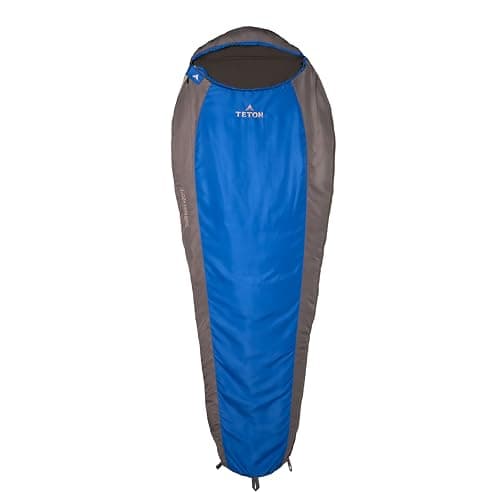
Teton Sports TrailHead 20˚F Mummy Sleeping Bag
1,579 g (3 lb 7.7 oz)$50–$100 band1.7 / 101,579 g with a label that reads 20F and a maker-published comfort range of 45-50F. The clearest example on the site of a bag whose weight and whose rating are both worth checking.
$64.99Amazon#ad · Price as of November 3, 2026 · Affiliate disclosure for the link to Teton Sports TrailHead 20˚F Mummy Sleeping Bag
Photos are illustrative, not the product. Scores are spec-derived.
The Teton is the instructive one. Teton states on its own page that its ratings are survival ratings, and publishes a 45-50°F comfort range for a bag labeled 20°F. So it is not a 1,579 g 20°F bag; it is a 1,579 g 45°F bag. Against the Kelty Cosmic Synthetic 40 at 1,021 g (2 lb 4.0 oz) it saves nothing at all. That is the whole case for reading weight and rating together.
The floor is set by quilts, not bags
If your only question is “how light can this get”, the answer is not a bag. Deleting the hood, the zip and the compressed underside takes a 20°F sleep system from roughly 1,100 g to roughly 550 g — a 556 g (1 lb 3.6 oz) saving, which is more than most people save on a tent upgrade and usually cheaper.
The cost is that a quilt drafts if you are a restless sleeper, needs a warmer pad underneath, and has no hood. Quilt vs sleeping bag sets out who should and should not make that trade. If the answer is a bag, the target weights above are the ones to hold makers to.
What share of your base weight it should be
A useful cross-check: your sleeping bag or quilt should be roughly 10-15% of your base weight. At a 12 lb (5.4 kg) base weight that is 540-810 g, which is quilt territory. At a 20 lb (9 kg) base weight it is 900-1,350 g, which is exactly the three-season down mummy band.
If your bag is more than about 20% of your base weight, it is the right thing to upgrade next. If it is less than 10%, you have probably bought an expensive quilt and are still carrying a heavy tent — check the big three before spending more on sleep.
Not sure what your base weight is? Start with what is base weight, then how to lower it.
When a heavier bag is the right buy
- You camp in sustained damp. Synthetic fill keeps more of its warmth wet and dries faster. That costs 300-500 g for the same rating, and in a Pacific Northwest autumn it is worth it. See down vs synthetic.
- You are not actually backpacking yet. If the bag is for car camping and the occasional mile-and-a-half walk-in, comfort, durability and price beat grams every time. Our backpacking vs regular bag comparison covers that honestly.
- You sleep cold. Going one rating band colder is roughly 150-250 g, and it is cheaper than being awake.
- You need a wide cut. Roomier bags use more fabric and more fill. If a mummy bag feels like a straitjacket, the grams are buying you sleep — see bags for side sleepers.
How to cut bag weight without buying one
- Bin the compression sack. A compression sack can add 50-60 g and compressing down hard damages it. Stuff the bag loose in the bottom of your pack instead.
- Pair it with a warmer pad. You can often use a bag you already own at a lower temperature by fixing the ground side. See R-value explained.
- Wear your insulation at night. A puffy and a hat you are already carrying extend a bag by several degrees, which may let you take a lighter one.
- Store it uncompressed at home. Down that has been crushed in a stuff sack for a year lofts worse, which is a warmth loss you paid for in grams.
- Weigh it yourself. Makers publish different figures for different sizes and sometimes for the same one. Your kitchen scale is the only number that counts for your pack.
If after all that the bag is still the heaviest sleep item you own, the ranked options are on best budget backpacking sleeping bags and best 20 degree sleeping bags.
How we scored this
How these picks were chosen
Every weight and list price here comes straight from the maker's own product page, measured against a named mainstream reference, then turned into one number: grams saved per dollar. Every figure links to the page it came from, so you can check any of it in a click.
Value and weight are computed from those published numbers; function, durability and ease are scored from the specs, manuals and standards each maker publishes. Commissions never set a score or decide a pick. The formula, weights and references are published.
What changed
- Published.
Questions
Frequently asked
How much should a backpacking sleeping bag weigh?
Is a 2 lb sleeping bag good for backpacking?
Why are synthetic sleeping bags so much heavier?
Does fill power make a bag lighter?
How light can a 20 degree sleep system get?
Receipts
Sources
- Hyke & Byke: Eolus 30F 800FP Down Sleeping Bag product page (checked 2026-09-22)
- Hyke & Byke: Eolus 15F 800FP Down Sleeping Bag product page (checked 2026-09-22)
- Kelty: Cosmic Down 20 product page, 16.4 oz of 550 fill (checked 2026-09-22)
- Paria Outdoor Products: Thermodown 15 Sleeping Bag product page (checked 2026-09-22)
- Teton Sports: TrailHead 20F Mummy Sleeping Bag product page, comfort range (checked 2026-09-22)
- Therm-a-Rest: Vesper 20F/-6C Down Quilt product page (checked 2026-09-22)
Weights, list prices and specs on this page come from each maker's own pages, linked on every product, and performance figures such as boil times or flow rates are the maker's claims, labeled that way, so you always know whose number you're reading. Amazon sets its own prices and changes them often, so buy buttons link to the live listing. Read the full method.