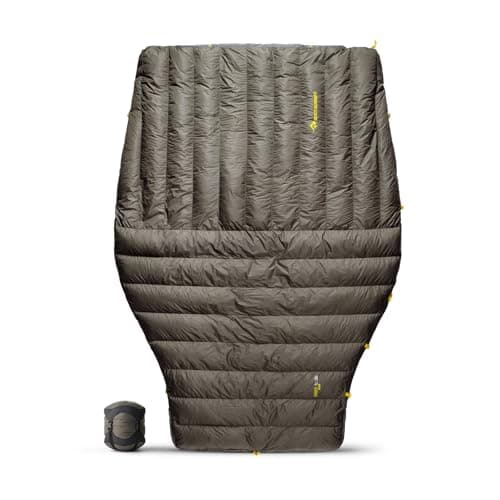
Fill power is the number that decides what a down quilt or sleeping bag costs. Shop the sleep category for an afternoon and you will see 550, 650, 700, 800 and 900 on otherwise similar-looking products, with prices that climb right alongside. Almost every buying guide tells you higher is better and stops there, which is not wrong, but it is not useful either: it doesn't tell you what you are actually getting for the money, or when paying for the bigger number is a waste.
So here is the whole thing, with a source for every claim: what the number measures, how it is produced, and what it does and does not predict. The short version, which the rest of this page earns, is that fill power is a weight spec dressed up as a warmth spec. Buy it for grams, not for degrees.
What fill power measures
Fill power measures loft per unit of mass: how much space a fixed amount of down takes up once it has fully expanded. The International Down and Feather Testing Laboratory, which runs the industry test, puts it plainly — “Fill Power measures the loft or insulation properties of down products.” Under the USA convention the result is reported in cubic inches, and IDFL notes that “extremely high quality down will have a fill power of 700+ in3.”
That is the whole definition. A number like 800 means that mass of down lofted to 800 cubic inches in the test. It is a measure of the quality of the down clusters — bigger, more mature clusters trap more air for their weight — and nothing else. It says nothing about how much down is in the bag, how the baffles are built, how thick the shell is, or what temperature the finished product is rated to.
Warmth, meanwhile, comes from loft: the thickness of still air trapped above you. That is not a claim we are making from theory — it is how at least one maker on this site derives its ratings. Paria Outdoor Products rates its quilts from measured loft, pairing roughly 3 inches of loft with its 15°F figure and 2.0 inches with its 30°F figure, and states on the same page that its bags and quilts do not carry EN/ISO testing. So the chain runs: down quality (fill power) × amount of down (fill weight) → loft → warmth. Fill power is the first link, not the last.
How the number is produced
The test is standardized, which is the reason the number is worth anything at all. IDFL lists the current method as Fill Power (Steam Conditioning), IDFB 10-B — the International Down and Feather Bureau's own regulation, with steam as the official conditioning step.
Mechanically, IDFL describes the procedure like this: the sample is conditioned, then “the down is placed in a fill power measuring cylinder and is either blown with air or stirred with stirring sticks. A piston is then lowered onto the down, and the fill power is measured where the piston stops moving.” The conditioning step is not a formality. Down that has been compressed in shipping reads low until it is allowed to recover, which is why the standard specifies how to recondition it before measuring.
One more thing the standard explains: why fill power figures from different brands are comparable in the first place. A shared test method is what makes “800-fill” on a budget quilt mean the same thing as “800-fill” on a premium one. Temperature ratings, as our sleeping bag temperature ratings guide shows, are nowhere near as consistent: plenty of makers publish a number they estimated themselves. Fill power is the more trustworthy of the two specs, which is a good reason to understand it properly.
Fill power vs fill weight: the distinction that matters
There are two down numbers on a well-documented product page, and the less famous one does more work:
- Fill power — the loft per unit mass of the down itself. A quality grade.
- Fill weight — how many grams or ounces of that down the maker actually stuffed into this size. A quantity.
Total loft, and therefore warmth, is driven by both together. A quilt with 900-fill down and very little of it is a summer quilt. A bag with 550-fill down and a lot of it can be genuinely warm — it will just be heavy and bulky, because low-fill-power down needs more mass to reach the same thickness.
That is exactly what the published numbers show on this site. The Kelty Cosmic Down 20 uses 550 fill down and Kelty lists 16.4 oz (464 g) of it; it is rated 20°F by Kelty's own reckoning and weighs 1,106 g (2 lb 7.0 oz). The Therm-a-Rest Vesper 20 uses 900-fill down and Therm-a-Rest lists 12.5 oz (360 g) of it for an EN-tested 20°F limit, at 550 g (1 lb 3.4 oz). Roughly a quarter less down, a comparable headline rating, and 556 g (1 lb 3.6 oz) less to carry. That gap is the entire case for fill power, stated as honestly as we can state it.
550 to 900 fill, with real numbers
Below is the fill-power ladder as it actually appears across the down bags and quilts we track, with each maker's own fill power, fill weight and listed total weight. Every figure comes from the maker's own product page.
- 550 fill — Kelty Cosmic Down 20: 16.4 oz (464 g) of down, 1,106 g (2 lb 7.0 oz) total, rated 20°F by Kelty. The lowest fill power in our catalog and the heaviest down bag in it.
- 650+ fill — Zenbivy Core Quilt 25: 395 g (13.9 oz) of 80/20 gray duck down, no water-resistant treatment, 737 g (1 lb 10.0 oz) total at 25°F.
- 700 fill — Paria Thermodown 15 Sleeping Bag: 25.8 oz of down, 1,134 g (2 lb 8.0 oz) total, Paria's own 15°F rating.
- 800 fill — Paria Thermodown 15 Quilt (20 oz of down, 936 g (2 lb 1.0 oz)), Paria Thermodown 30 Quilt (14 oz, 765 g (1 lb 11.0 oz)), Hyke & Byke Eolus 15 (620 g (1 lb 5.9 oz) of down, 1,152 g (2 lb 8.6 oz)) and the Outdoor Vitals StormLoft 30 (350 g (12.3 oz) of ExpeDRY-treated down from Allied Feather, 556 g (1 lb 3.6 oz)). This is the sweet spot of the category by volume of product.
- 850 fill — Enlightened Equipment Revelation 20: 16.08 oz of gray duck down from an RDS-certified supplier, 639 g (1 lb 6.5 oz) total at 20°F.
- 900 fill — Therm-a-Rest Vesper 20: 12.5 oz (360 g) of PFAS-free hydrophobic goose down, 550 g (1 lb 3.4 oz) total, EN limit 20°F and EN comfort 32°F. The highest fill power and the lightest cold-rated piece we track.
Read down that list and the pattern is clear but not linear. Going from 550 to 900 fill roughly halves the weight of a 20°F piece. Going from 800 to 850 changes very little, and costs a lot. The useful question is never “is higher better” — it is “where does the curve flatten,” and on this evidence it flattens hard somewhere around 800.
Our picks for this
One piece at each rung of the ladder
The same four fill powers as products you can actually buy, so you can see what each step costs. Every weight and fill figure here is the maker's own.
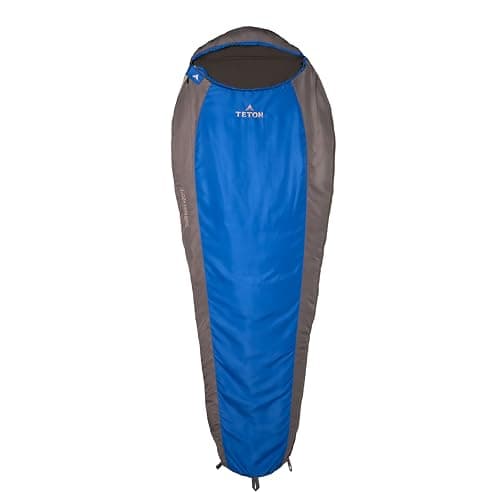
Budget full-zip 20°F bag
Kelty Cosmic Down 20 Sleeping Bag
1,106 g (2 lb 7.0 oz)$150–$200 band4.0 / 10550 fill, the bottom of the ladder: a full-featured mummy bag with hood, draft tube and full zip, at the price of the low fill power in carried weight and bulk.
Check price · Amazon#ad · Price as of November 3, 2026 · Affiliate disclosure for the link to Kelty Cosmic Down 20 Sleeping Bag
Best budget down mummy bag
Paria Thermodown 15 Sleeping Bag
1,134 g (2 lb 8.0 oz)$150–$200 band4.2 / 10700 fill in a full-zip bag. Note the honest lesson: it carries more down than the 800-fill Eolus 15 and still lands at a near-identical total weight, because fabric and cut matter too.
Check price · Amazon#ad · Price as of November 3, 2026 · Affiliate disclosure for the link to Paria Thermodown 15 Sleeping Bag
Best budget three-season quilt
Paria Thermodown 15 Down Quilt
936 g (2 lb 1.0 oz)$200–$300 band6.0 / 10800 fill is where the weight curve stops paying off quickly, and this is the cheapest genuine 800-fill cold-rated piece we track. The 15°F figure is Paria's own loft estimate, not an EN/ISO test.
Check price · Amazon#ad · Price as of November 3, 2026 · Affiliate disclosure for the link to Paria Thermodown 15 Down Quilt
Lightest EN-rated 20°F quilt
Therm-a-Rest Vesper 20F/-6C Down Quilt
550 g (1 lb 3.4 oz)$400–$500 band7.4 / 10900 fill with EN-tested ratings and the lightest cold-rated piece here, but it costs more than twice the Paria quilt and uses the most delicate 10D fabric in the group.
$459.95Amazon#ad · Price as of November 3, 2026 · Affiliate disclosure for the link to Therm-a-Rest Vesper 20F/-6C Down Quilt
Photos are illustrative, not the product. Scores are spec-derived.
When 800-fill isn't 800-fill
This is the part most fill-power explainers skip, and it is the part that actually saves a budget buyer money. Look again at the 800-fill group above. The Paria Thermodown 30 Quilt holds 14 oz of 800-fill down and weighs 765 g (1 lb 11.0 oz). The Outdoor Vitals StormLoft 30 holds a comparable 350 g (12.3 oz) of 800-fill down for the same 30°F rating and weighs 556 g (1 lb 3.6 oz) — 209 g (7.4 oz) lighter at the same fill power and the same stated rating.
Where did that go? Mostly into fabric. Paria lists 20D ripstop nylon for both shell and lining on its quilts. The lightest quilts here run 10D. Shell weight, baffle construction, cut, zipper hardware and draft collars all add grams that have nothing to do with the down, and on a finished product they can easily outweigh a fill-power step.
The starkest version is the pair of 15°F bags. Paria's Thermodown 15 bag uses 700-fill down and 25.8 oz of it, for 1,134 g (2 lb 8.0 oz). The Hyke & Byke Eolus 15 uses 800-fill down and less of it (620 g (1 lb 5.9 oz)), for 1,152 g (2 lb 8.6 oz) — which is actually the heavier of the two, by a small margin. A full fill-power grade of difference, and the better down did not produce a lighter bag.
Which is the same conclusion our budget quilt rankings and budget sleeping bag rankings reach from the other direction: they rank on grams saved per dollar against a reference product, which is a total-weight measure. Fill power never enters the score. It is an input to the thing we score, not the thing itself.
What to buy at each fill power
Translating all of that into a buying decision, for the kind of buyer this site is written for:
- 550 to 650 fill: buy it only if the price is the point and the bulk genuinely doesn't matter — car camping, a spare bag, a kid's bag, a first bag before you know whether you'll keep backpacking. For a pack you carry all day, low-fill-power down is the one spec that costs you both weight and volume at once.
- 700 fill: a reasonable floor for real backpacking, and often the cheapest way into down at all. Accept that you are carrying more grams of down than you need to.
- 800 fill: where we would spend. It is where the weight curve stops paying off quickly, and it is now common enough at budget prices that you rarely need to go above it. Four of the nine down pieces we track sit here.
- 850 to 900 fill: buy it when grams are genuinely the deciding factor and you have already cut the easier weight elsewhere, or when you want EN-tested ratings, which in our catalog only appear on the highest-fill-power pieces. Expect to pay more than double for the step up from 800.
If you don't yet know whether down is the right choice at all — it isn't always, especially for wet trips and tight budgets — read down vs synthetic insulation before you shop fill power at all. Fill power is a question you only need to answer after you have chosen down.
Treated down, RDS and the other label words
Fill power sits next to several other down claims on a product page, and they are different things:
- Hydrophobic or treated down (Therm-a-Rest's PFAS-free hydrophobic down, Hyke & Byke's hydrophobic 800 FP, Outdoor Vitals' ExpeDRY from Allied Feather) is a coating applied to the clusters so they resist absorbing moisture and losing loft. It is a durability-in-the-wet claim, not a warmth or weight claim, and it does not change fill power.
- RDS-certified is the Responsible Down Standard, an animal-welfare traceability certification for the supply chain. Paria, Enlightened Equipment, Therm-a-Rest and Sea to Summit all cite it on the pieces we track. It tells you nothing about performance.
- Goose vs duck down is a species claim, not a grade. Goose clusters can reach higher fill powers at the top end, which is why most 850+ products are goose, but an 800-fill duck down and an 800-fill goose down lofted the same amount in the same test. Paria's 800-fill is duck; Therm-a-Rest's 900-fill is goose.
- Down/feather ratios like Zenbivy's 80/20 or Hyke & Byke's 90/10 describe how much of the fill is down cluster versus feather. Feather is cheaper, heavier and lofts less.
None of those four is a reason to pay for a higher fill power, and none of them substitutes for one. Treat them as separate boxes on a checklist.
What fill power can't tell you
It can't tell you a temperature. There is no conversion from fill power to degrees, because the answer depends on fill weight, baffle design, cut and the shell — and on whose rating you are reading. Only two pieces in our whole sleep catalog carry EN-tested ratings; the rest publish a figure the maker produced itself, sometimes from loft, sometimes with no stated method at all.
It can't tell you how a specific bag will hold its loft over years of use. No maker publishes a loft-retention figure, and we rank gear from published specifications, so we have no basis for a durability claim either way. What we can say is that fabric denier is published, and the lightest pieces here use the most delicate fabrics.
And it can't be verified by you at the point of sale. You are trusting the maker's claim of a lab result. IDFL notes that for finished products the measured fill power should fall within ±5% of the claim after proper conditioning, but that is a tolerance for a testing lab, not something you can check at home with a tape measure.
What this means for your budget
If you take one thing from this page: fill power is the spec that most reliably separates a heavy down bag from a light one, and the least reliable way to compare two specific products. Shop the total weight at the rating you need, then look at fill power to understand what you are paying for.
For most people shopping this site, 800-fill is the right place to stop. It is where our budget quilt picks cluster, it is available from more than one maker at genuinely budget prices, and the step above it costs far more than the grams are worth unless you are already deep into cutting base weight. If you are, the honest next move is usually not a better quilt at all — it is reading how to lower your base weight and finding the cheaper grams elsewhere in the pack first.
How we scored this
How these picks were chosen
Every weight and list price here comes straight from the maker's own product page, measured against a named mainstream reference, then turned into one number: grams saved per dollar. Every figure links to the page it came from, so you can check any of it in a click.
Value and weight are computed from those published numbers; function, durability and ease are scored from the specs, manuals and standards each maker publishes. Commissions never set a score or decide a pick. The formula, weights and references are published.
Questions
Frequently asked
What does 800 fill power mean?
Is 800 fill power warmer than 650?
Is 650 fill down good enough for backpacking?
Why do two 800-fill quilts weigh different amounts?
How is fill power tested?
Does hydrophobic treatment change fill power?
Is goose down better than duck down?
Should I pay more for 900 fill power?
Receipts
Sources
- IDFL (International Down and Feather Testing Laboratory): Explanation of Down and Feather Tests, fill power test procedure and definition (checked 2026-10-09)
- IDFL: Test Names & Standards List, Fill Power (Steam Conditioning) = IDFB 10-B (checked 2026-10-09)
- Paria Outdoor Products: Gear FAQ, Temperature Ratings — loft-based ratings, no EN/ISO testing (checked 2026-09-22)
- Paria Outdoor Products: Thermodown 15 Down Quilt product page (checked 2026-09-22)
- Paria Outdoor Products: Thermodown 15 Sleeping Bag product page (checked 2026-09-22)
- Paria Outdoor Products: Thermodown 30 Down Quilt product page (checked 2026-09-22)
- Kelty: Cosmic Down 20 Sleeping Bag product page, 550 fill and 16.4 oz fill weight (checked 2026-09-22)
- Therm-a-Rest: Vesper 20F/-6C Down Quilt product page, 900-fill and EN ratings (checked 2026-09-22)
- Enlightened Equipment: Revelation Sleeping Quilt product page, 850 fill-power gray duck down (checked 2026-09-22)
- Hyke & Byke: Eolus 15°F 800FP Goose Down Sleeping Bag product page (checked 2026-09-22)
- Outdoor Vitals: StormLoft Down TopQuilt product page, 800-fill ExpeDRY down from Allied Feather (checked 2026-09-22)
- Zenbivy: Core Quilt product page, 650+ fill-power 80/20 gray duck down (checked 2026-09-22)
Weights, list prices and specs on this page come from each maker's own pages, linked on every product, and performance figures such as boil times or flow rates are the maker's claims, labeled that way, so you always know whose number you're reading. Amazon sets its own prices and changes them often, so buy buttons link to the live listing. Read the full method.