The contenders
Side by side
 Illustrative photo
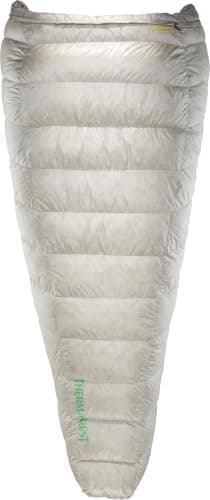
The backpacking bag
Paria Thermodown 15 Sleeping Bag
4.2 / 10A tapered down mummy at about a kilogram: the shape and fill a bag has to have to be worth carrying.
Check price · Amazon#ad · Price as of November 3, 2026 · Affiliate disclosure for the link to Paria Thermodown 15 Sleeping Bag
- Illustrative photo
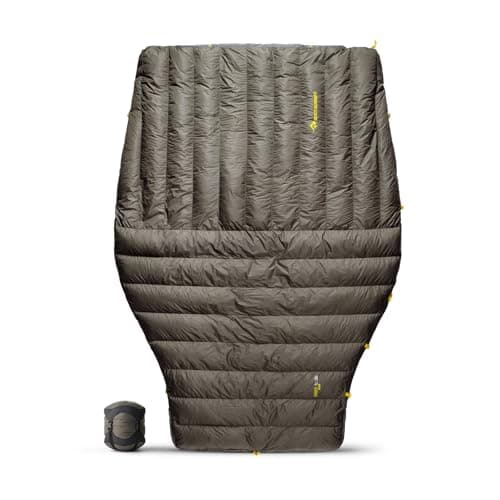
The roomy backpacking bag
Kelty Cosmic Down 20 Sleeping Bag
4.0 / 10A wider mummy with published girths, at almost the same weight. This is the compromise most people should make.
Check price · Amazon#ad · Price as of November 3, 2026 · Affiliate disclosure for the link to Kelty Cosmic Down 20 Sleeping Bag
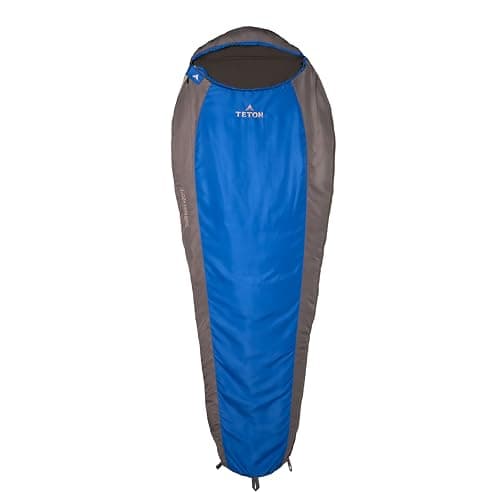
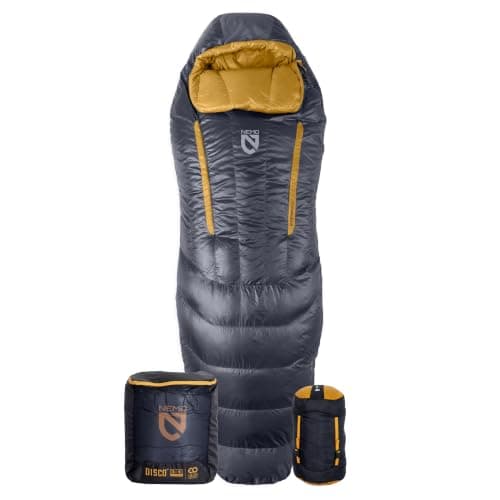
The budget backpacking bag
Teton Sports TrailHead 20˚F Mummy Sleeping Bag
1.7 / 10A synthetic mummy at the lowest list price we track. It is 1.7 kg, which is the price of that price.
$64.99Amazon#ad · Price as of November 3, 2026 · Affiliate disclosure for the link to Teton Sports TrailHead 20˚F Mummy Sleeping Bag
- Illustrative photo
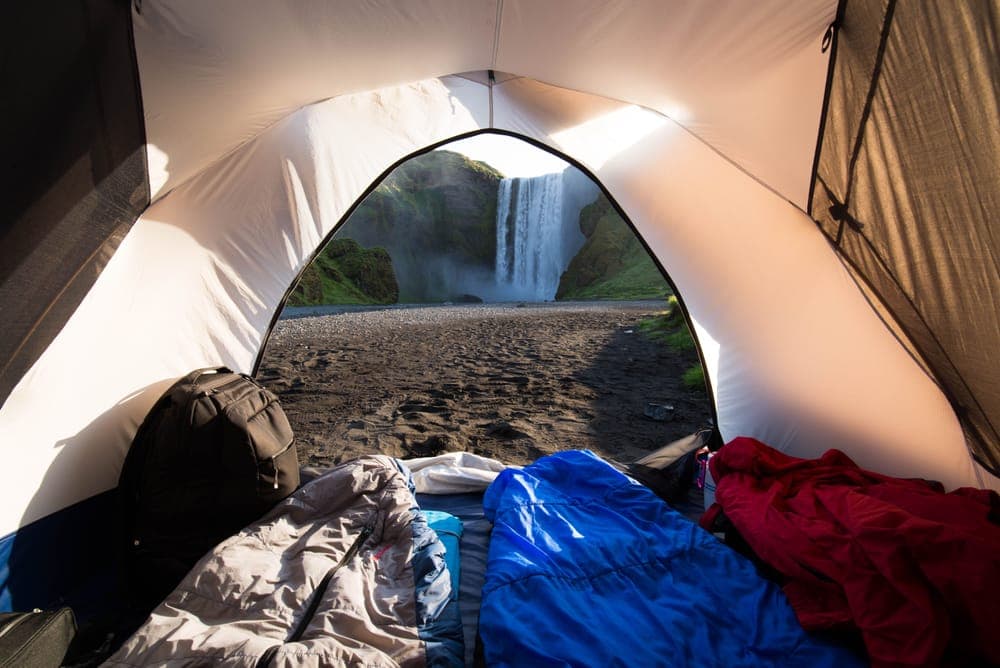
The regular camping bag
Teton Sports Celsius 20 (Large)
2.3 / 10Rectangular, 33 in wide, unzips into a blanket, and 2.2 kg. By Teton's own figures its comfort range is 45-50F.
Check price · Amazon#ad · Price as of November 3, 2026 · Affiliate disclosure for the link to Teton Sports Celsius 20 (Large)
“Backpacking sleeping bag” and “regular sleeping bag” describe two genuinely different products that happen to do the same job. Nobody labels them clearly, the temperature numbers on them are not comparable, and the price difference runs the opposite way to what most people expect — the bag that is worse at camping costs more.
This page compares four bags we track, all with a maker-stated rating of 20 °F or colder: two down backpacking mummies, a budget synthetic backpacking mummy, and a rectangular camping bag. Every number comes from the maker's own page and is linked.
The four real differences
The numbers side by side
The two down backpacking bags.
| Published spec | Paria Thermodown 15 Sleeping Bag | Kelty Cosmic Down 20 Sleeping Bag |
|---|---|---|
| Weight | 1,134 g (2 lb 8.0 oz) | 1,106 g (2 lb 7.0 oz) |
| List price | $150–$200 band | $150–$200 band |
| Value | Value 2.5/10 | Value 3.0/10 |
| Rating | 15°F (-10°C) (Paria rating; Paria states it does not have EN/ISO testing) (as stated) | 20°F (-7°C) (Kelty rating; no ISO/EN values listed on the product page) (as stated) |
| Fill | RDS-certified 700 fill-power duck down, 25.8 oz fill (Regular) | 550 fill down, 16.4 oz (464 g) fill (Regular) |
| Length | — | — |
| Score | 4.2 / 10 | 4.0 / 10 |
The budget synthetic mummy and the rectangular camping bag.
| Published spec | Teton Sports TrailHead 20˚F Mummy Sleeping Bag | Teton Sports Celsius 20 (Large) |
|---|---|---|
| Weight | 1,579 g (3 lb 7.7 oz) | 2,223 g (4 lb 14.4 oz) |
| List price | $50–$100 band | $50–$100 band |
| Value | No grams saved vs the reference | No grams saved vs the reference |
| Rating | 20°F (-7°C) survival rating; Teton lists a comfort temperature rating of 45°F to 50°F and suggests adding 20-30 degrees for comfort (as stated) | Teton states its numbers are SURVIVAL ratings and lists the 20°F bag's comfort range as 45°F to 50°F; it recommends adding 20-30 degrees to any listed rating (as stated) |
| Fill | PolarLite synthetic insulation; polyester and diamond ripstop PFAS-free shell; micro polyester liner | SuperLoft Elite single-channel hollow fiber, offset double-layer construction |
| Shell | — | 100% polyester 70D/190T taffeta with a PFAS-free water-repellent finish; 75D polyester flannel liner |
| Warranty | Teton Lifetime Warranty | Teton Lifetime Warranty |
| Score | 1.7 / 10 | 2.3 / 10 |
1,089 g (2 lb 6.4 oz) separates the lightest backpacking bag here from the camping bag, for two bags with a similar number printed on the label. That gap is the entire subject of this page.
Weight and bulk
Weight is the obvious difference and volume is the decisive one. A backpacking bag is designed to compress: the NEMO bags we rank publish compressed volumes between 5 and 11 L, and our budget bag ranking is full of bags that stuff to the size of a loaf of bread. A camping bag's hollow-fibre fill does not compress like that, and Teton publishes a pack size that makes the point without any editorialising.
There is a second bulk cost nobody mentions: Teton publishes a “pack weight” for the Celsius of 6.37 to 9.13 lbs for the Large, separate from its item weight. Whatever that figure covers, it is a long way from a bag you carry.
The temperature rating trap
This is where the comparison gets genuinely misleading, and it is not the buyer's fault. Both Teton bags and the Celsius in particular use survival ratings — and Teton says so, in its own words, on its own page: the numbers are the coldest temperature the bag is designed to keep you alive in, and it recommends adding 20 to 30 degrees for comfort. For the 20 °F Celsius, Teton publishes a comfort range of 45 to 50 °F.
So a bag labelled 20 °F is, on the maker's own figures, comfortable at about 47 °F. That is a summer bag. Meanwhile our reference backpacking bag, the Kelty Cosmic Synthetic 20, is a 1,276 g (2 lb 13.0 oz) synthetic mummy whose 20 °F figure Kelty publishes without naming a test standard either — which is why this site prints the basis alongside every rating rather than the number alone.
The practical rule: compare ratings only between bags whose basis you can read, and when you cannot, compare fill weight and loft instead. The Kelty Cosmic Down 20 publishes 464 g of 550 fill down; the Celsius publishes no fill weight at all.
When the regular bag is the right buy
More often than a gear site usually admits. A rectangular camping bag beats a backpacking bag on four real counts, and none of them is a minor point.
Comfort. 33 in of width means you can lie on your side, cross your legs and sit up. A mummy does none of those things. If you sleep badly in mummies, that is not a character flaw and the fix is a wider bag.
Versatility. The Celsius unzips into a camp blanket with a two-way L-zip. A mummy bag unzipped is a badly shaped blanket.
Price. The Celsius Large costs a fraction of either down bag here, with a Teton lifetime warranty behind it.
Durability under abuse. A 70D/190T taffeta shell and a 75D flannel liner shrug off treatment that would wreck a 10D or 20D backpacking shell. For a bag that lives in a car boot and gets used by children, that matters.
What it cannot do is go in a pack. If your trips are car camping, a festival, a spare bed or a cabin, buy the camping bag and spend the difference on a better pad, which affects your sleep more than either bag.
The verdict
One more route worth knowing about, because it wins outright on weight: a quilt. Remove the back of the bag, strap it to your pad and you lose the hood, the zip and several hundred grams. Our quilt versus sleeping bag comparison covers when that is the better answer than either bag on this page.
In detail
The contenders, in full
Illustrative photoThe backpacking bag
Paria Thermodown 15 Sleeping Bag
A tapered down mummy at about a kilogram: the shape and fill a bag has to have to be worth carrying.
Published specsFrom the maker, with the source linked
| Weight | 1,134 g (2 lb 8.0 oz) (listed weight, Regular (2 lb 8 oz, converted)) |
|---|---|
| List price | $150–$200 MSRP band (per pariaoutdoorproducts.com, checked Sep 2026) |
| Value | Value 2.5/10vs the reference Kelty Cosmic Synthetic 20 at 1,276 g (2 lb 13.0 oz) |
| Temperature rating | 15°F (-10°C) (Paria rating; Paria states it does not have EN/ISO testing)As stated |
| Fill | RDS-certified 700 fill-power duck down, 25.8 oz fill (Regular) |
| Shell / lining | 20D ripstop nylon shell and lining, PFC-free DWR |
| Size (Regular) | 82.5 x 31.5 in; Regular is sized up to 6 ft |
| Zipper | Large two-way YKK zipper that opens from top and bottom, wide zipper guard |
| Packed size | 10 x 6 in |
How the 4.2 score breaks down
- Grams per dollar (35%, computed)
- 2.5
- Weight (20%, computed)
- 2.0
- Warmth for the weight (25%)
- 6.5
- Materials & durability (10%)
- 7.0
- Ease & versatility (10%)
- 6.0
What the specs support
- Full-length two-way zipper vents from the top or the bottom
- Three sizes: Short to 5'6", Regular to 6 ft, and Long
- 20D shell and lining, same as Paria's quilts
Where it falls short
- About 200 g heavier than Paria's own Thermodown 15 quilt
- The 15°F rating is Paria's own, not an ISO/EN test
- 700-fill down, a step below the 800-fill Thermodown quilts
Skip it if…
Skip it if you sleep on an insulated pad and don't need a hood: Paria's Thermodown 15 quilt costs a little more but is about 200 g lighter.
#ad · Price as of November 3, 2026 · Affiliate disclosure for the link to Paria Thermodown 15 Sleeping Bag
Illustrative photoThe roomy backpacking bag
Kelty Cosmic Down 20 Sleeping Bag
A wider mummy with published girths, at almost the same weight. This is the compromise most people should make.
Published specsFrom the maker, with the source linked
| Weight | 1,106 g (2 lb 7.0 oz) (listed weight, Regular (2 lb 7 oz, converted)) |
|---|---|
| List price | $150–$200 MSRP band (per kelty.com, checked Sep 2026) |
| Value | Value 3.0/10vs the reference Kelty Cosmic Synthetic 20 at 1,276 g (2 lb 13.0 oz) |
| Temperature rating | 20°F (-7°C) (Kelty rating; no ISO/EN values listed on the product page)As stated |
| Fill | 550 fill down, 16.4 oz (464 g) fill (Regular) |
| Shell / liner | Recycled 20D nylon taffeta shell, recycled 50D polyester taffeta liner, PFAS-free DWR |
| Size (Regular) | 78 in long; 62 in shoulder, 58 in hip, 46 in foot circumference; fits to 6 ft |
| Zipper | Quad-stitch anti-snag zipper, dual locking sliders, full draft tube and collar |
| Stuff sack | 8 x 13 in (Regular), included |
How the 4.0 score breaks down
- Grams per dollar (35%, computed)
- 3.0
- Weight (20%, computed)
- 2.3
- Warmth for the weight (25%)
- 5.0
- Materials & durability (10%)
- 6.0
- Ease & versatility (10%)
- 6.0
What the specs support
- Full zipper, hood and draft collar for sleepers who don't want a quilt
- Three lengths, fitting from 5'6" to 6'6"
- Trapezoidal baffles and an expanded footbox
Where it falls short
- 550-fill down is the lowest fill power in this group
- At 1,106 g (39.0 oz) it is heavier than every quilt here
- 20°F is Kelty's own rating; no ISO figures are listed
Skip it if…
Skip it if weight is why you're shopping: it saves only about 170 g over Kelty's synthetic Cosmic 20, and Paria's Thermodown 15 quilt is about 170 g lighter still.
#ad · Price as of November 3, 2026 · Affiliate disclosure for the link to Kelty Cosmic Down 20 Sleeping Bag
The budget backpacking bag
Teton Sports TrailHead 20˚F Mummy Sleeping Bag
A synthetic mummy at the lowest list price we track. It is 1.7 kg, which is the price of that price.
Published specsFrom the maker, with the source linked
| Weight | 1,579 g (3 lb 7.7 oz) (listed weight, Large (3.48 lb, converted; Teton sells Large and Short only)) |
|---|---|
| List price | $50–$100 MSRP band (per tetonsports.com, checked Sep 2026) |
| Value | No grams saved vs the referencevs the reference Kelty Cosmic Synthetic 40 at 1,021 g (2 lb 4.0 oz) |
| Temperature rating | 20°F (-7°C) survival rating; Teton lists a comfort temperature rating of 45°F to 50°F and suggests adding 20-30 degrees for comfortAs stated |
| Fill / fabrics | PolarLite synthetic insulation; polyester and diamond ripstop PFAS-free shell; micro polyester liner |
| Size (in use) | Large 87 x 32 in at the shoulders x 22 in at the foot; Short 75 x 30 x 20 in |
| Pack size | Large 14.5 x 7.75 x 7.25 in; stuff sack included |
| Zipper / features | Full-length anti-snag zipper (right side), draft collar and hood, interior pocket |
| Warranty | Teton Lifetime Warranty |
How the 1.7 score breaks down
- Grams per dollar (35%, computed)
- 0.0
- Weight (20%, computed)
- 0.0
- Warmth for the weight (25%)
- 3.0
- Materials & durability (10%)
- 5.0
- Ease & versatility (10%)
- 4.0
What the specs support
- The lowest list price of any bag or quilt in this group
- Full-length anti-snag zipper, draft collar, hood and interior pocket
- Oversized cut: Teton lists 3 in more width and 2 in more length than standard mummy bags
- Teton Lifetime Warranty
Where it falls short
- Teton itself says the 20°F figure is a survival rating, with comfort at 45°F to 50°F
- At 1,579 g (55.7 oz) it is about 558 g heavier than the Kelty Cosmic Synthetic 40 reference bag
- Packs to 14.5 x 7.75 x 7.25 in (Large), a lot of pack space for a summer bag
Skip it if…
Skip it if your nights drop below 45°F: Teton lists comfort at 45°F to 50°F and calls the 20°F number a survival rating.
#ad · Price as of November 3, 2026 · Affiliate disclosure for the link to Teton Sports TrailHead 20˚F Mummy Sleeping Bag
Illustrative photoThe regular camping bag
Teton Sports Celsius 20 (Large)
Rectangular, 33 in wide, unzips into a blanket, and 2.2 kg. By Teton's own figures its comfort range is 45-50F.
Published specsFrom the maker, with the source linked
How the 2.3 score breaks down
- Grams per dollar (35%, computed)
- 0.0
- Weight (20%, computed)
- 0.0
- Warmth for the weight (25%)
- 5.0
- Materials & durability (10%)
- 5.5
- Ease & versatility (10%)
- 5.0
What the specs support
- 33" wide in use: you can lie on your side, sit up and cross your legs in it.
- Unzips flat into a blanket, which no mummy bag here does.
- Lifetime warranty at the lowest list price of any bag we track.
Where it falls short
- Teton publishes its weight as a range rather than a figure per rating.
- Its own comfort range for the 20°F bag is 45-50°F, so the number on the label is not a three-season rating.
- The stuff sack alone is 18" x 11.5" x 11.5" — it will not fit inside a 55 L pack with anything else.
Skip it if…
Skip it if you are carrying it more than a few hundred metres from a car: at 2.2 kg and a sack the size of a football it is a car-camping bag, and Teton positions it as one.
#ad · Price as of November 3, 2026 · Affiliate disclosure for the link to Teton Sports Celsius 20 (Large)
How to choose between them
- Answer one question: does it go in a pack? If yes, buy a backpacking bag and stop reading. If no, buy the camping bag and spend the difference on a pad.
- Read the rating basis, not the number. Teton states its figures are survival ratings and publishes a 45-50 °F comfort range for its 20 °F bag. An ISO limit is a tested figure; a maker's own number is not.
- Compare packed size, not just weight. An 18 x 11.5 x 11.5 in stuff sack is most of a 55 L pack, whatever the bag weighs.
- Check the fill weight where it is published. The Kelty publishes 464 g of 550 fill down. The Celsius publishes no fill weight, which tells you something in itself.
- Be honest about how you sleep. If mummies keep you awake, a wide backpacking bag with published girths beats a narrow one you will not use.
- Consider two bags. A cheap rectangular bag for the car and a light mummy for the trail costs less than most single down bags, and each does its job properly.
Mistakes to avoid
- Taking a camping bag on a multi-day hike because it says 20 degrees. It is twice the weight, several times the volume, and by its maker's own comfort figures it is a summer bag.
- Buying a mummy for car camping because it is “better gear”. It is narrower, dearer and less durable, and none of that helps you 20 metres from a car.
- Comparing two ratings without checking the basis. A survival rating and an ISO comfort rating can differ by 30 degrees on the same number.
- Blaming the bag for a cold night on a thin pad. Ground conduction beats insulation every time. Read R-value explained first.
- Storing either bag compressed. Down and synthetic both lose loft permanently. Store loose in a large sack; both makers here say so.
How we scored this
How these picks were chosen
Every weight and list price here comes straight from the maker's own product page, measured against a named mainstream reference, then turned into one number: grams saved per dollar. Every figure links to the page it came from, so you can check any of it in a click.
Value and weight are computed from those published numbers; function, durability and ease are scored from the specs, manuals and standards each maker publishes. Commissions never set a score or decide a pick. The formula, weights and references are published.
What changed
- Published.
Questions
Frequently asked
What is the difference between a backpacking sleeping bag and a regular one?
Can you use a regular sleeping bag for backpacking?
Why are backpacking sleeping bags more expensive?
Is a 20-degree camping bag as warm as a 20-degree backpacking bag?
Is a rectangular sleeping bag ever better?
What if I want one bag for both?
Receipts
Sources
- Paria Outdoor Products: Thermodown 15 Backpacking Sleeping Bag product page (checked 2026-09-22)
- Kelty: Cosmic Down 20 Sleeping Bag product page (checked 2026-09-22)
- Teton Sports: TrailHead 20F Mummy Sleeping Bag product page (checked 2026-09-22)
- Teton Sports: Celsius Sleeping Bags product page, the rectangular camping bag (checked 2026-09-28)
- Kelty: Cosmic Synthetic 20 Sleeping Bag product page, this site's cold-class reference (checked 2026-09-22)
Weights, list prices and specs on this page come from each maker's own pages, linked on every product, and performance figures such as boil times or flow rates are the maker's claims, labeled that way, so you always know whose number you're reading. Amazon sets its own prices and changes them often, so buy buttons link to the live listing. Read the full method.