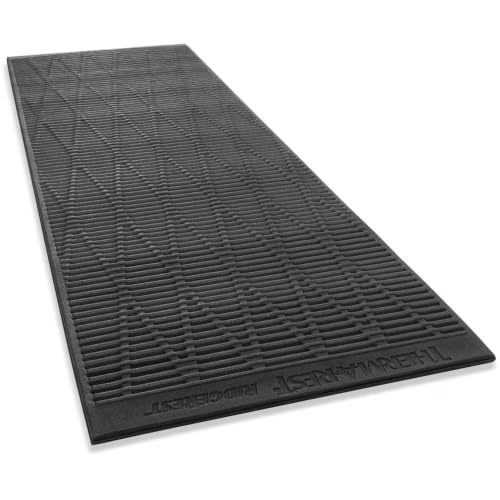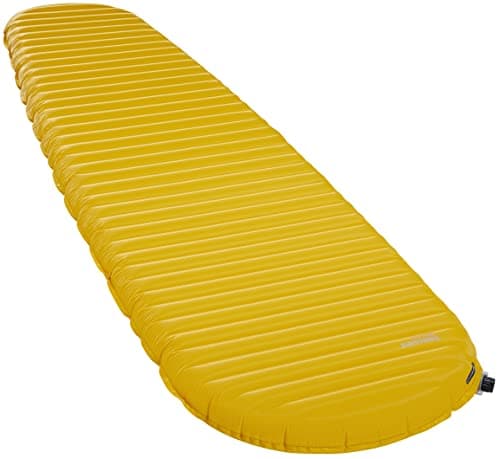
Almost everyone shopping for a sleep system starts with the bag or quilt, and almost everyone has the priority backwards. The ground is a far better conductor of heat than the air above you, and the insulation under your body is crushed flat by your own weight, which is precisely when loft stops working. The pad, not the bag, is what stands between you and that.
A 20°F quilt on a summer pad is a cold night. A 30°F quilt on a winter pad is usually fine. If you have a budget for exactly one upgrade, it belongs under you.
What a pad is actually for
Two jobs, and they are separate. The first is insulation: slowing conductive heat loss into the ground. The second is comfort: keeping your hips and shoulders off roots and stones so you actually sleep. A pad can be good at one and poor at the other, and the specification sheet tells you which.
Everything that follows is organized around that split, because the mistake that ruins trips is treating a pad as a mattress and buying on thickness alone.
1. R-value: the only warmth number
R-value measures resistance to heat flow. Higher is warmer, the scale is roughly linear, and — unusually for outdoor gear — it is now comparable between brands. Since the ASTM F3340 standard arrived, the major makers test the same way, so a 4.5 from one brand and a 4.5 from another mean the same thing. That is not true of sleeping bag temperature ratings, and it makes R-value the most trustworthy number in the whole sleep system.
Read the bands as a floor, not a target:
| When you camp | R-value to look for | What it looks like |
|---|---|---|
| Summer, above freezing | About 2 and up | A basic foam pad, or a light uninsulated air pad |
| Three-season, down to around freezing | 3 to 4 | An insulated air pad; the band most backpackers should buy |
| Shoulder season, nights below freezing | 4 to 5 | A four-season air pad, or a three-season pad with foam under it |
| Snow and frozen ground | 5 and up | A dedicated winter pad, often stacked with a foam pad |
Two things the table cannot capture. R-values stack, near enough additively: a 2.0 foam pad under a 4.5 air pad gives you about 6.5, which is a legitimate and cheap way to reach winter warmth with gear you already own. And sleeping cold is personal — if you are a cold sleeper, buy up a band rather than buying a warmer bag.
The long version, including how the test works and why older published numbers are not comparable, is in R-value explained.
2. Air, foam or self-inflating
Three constructions, three different failure modes. There is no best one; there is one that matches how you camp.
Inflatable air pads give the most warmth and the most comfort per gram, and they pack down to the size of a water bottle. They are also the only pads that can fail completely: a puncture at 2 a.m. puts you on the ground. Every reputable maker ships or sells a repair kit, and a patch takes five minutes, but you have to carry it.
Closed-cell foam pads cannot pop, cannot be punctured in any way that matters, cost a fraction as much, and double as a sit pad, a pack frame or a splint. They are also thin, usually under an inch, so they are hard sleeping for anyone who is not a back sleeper, and they are bulky: they ride outside the pack because they will not compress. They are the honest answer for thru-hikers who have decided reliability beats comfort, and the cheapest way to add warmth under another pad.
Self-inflating pads are foam-filled and open a valve to draw in air. They sit between the two on every axis, including weight, where they are usually the heaviest of the three for a given R-value. That is why few of them make it onto an ultralight list.
The head-to-head version of this argument, with the actual numbers, is in foam vs inflatable sleeping pads.
3. Size, shape and thickness
Length. A regular pad is typically 72 in (183 cm). If you are taller than about 6 ft, a long version costs grams but stops your feet hanging off the end onto cold ground. If you are shorter, or committed to cutting weight, a short or three-quarter pad under your torso plus a pack or spare clothing under your legs is a real strategy, not a compromise — your legs lose far less heat than your core.
Width. 20 in (51 cm) is standard and is genuinely narrow. Side sleepers and anyone who moves at night will roll off a 20 in pad; 25 in wide versions exist on most models for about 100 g more. That choice, specifically for side sleepers, is worked through on the side-sleeper pad page.
Thickness. Modern air pads run 3 to 4 in. More thickness keeps a hip off a root, which is the single biggest comfort factor for side sleepers, and it costs very little weight — most of a pad's mass is its fabric, not its air. It does cost pack volume and breaths.
What size sleeping pad do I need has the full sizing logic including the torso-length math.
4. Weight, and what it costs
Only now does weight come into it, because a pad that is too cold or too narrow is not lighter, it is useless. For context, every pad on this site is measured against the Therm-a-Rest Trail Scout (Regular) at 680 g (1 lb 8.0 oz), and the grams saved per dollar figure on each product card is calculated from that.
Rough expectations for a Regular size, from the makers' own figures: a three-season insulated air pad lands around 370-400 g, a true winter pad around 440 g, and a folding foam pad around 410 g. Notice what that means — a foam pad is not lighter than a good air pad. It is cheaper and more reliable, and those are the reasons to carry one. Anyone telling you foam is the ultralight choice is working from twenty-year-old numbers.
Noise, punctures and field repair
Three practical things no spec sheet lists properly.
Noise. Pads that use reflective internal films are warm for their weight and they crinkle. It is the most common complaint about the warmest ultralight pads and it bothers tent partners more than owners. If you share a tent, it is worth knowing before you buy rather than after.
Punctures. Not a matter of if, over enough nights. Carry the patch kit, clear the ground before you pitch, and use a groundsheet or a footprint if your tent floor is thin — the case for one is in do you need a tent footprint.
Inflation. Blowing a pad up by mouth puts moist breath inside it, which over years can grow mold in the baffles and, in winter, can freeze. Most quality pads now include a pump sack; use it. It is also faster at altitude, where you have less breath to spare.
Four pads across the range
One per approach: the three-season default, the thicker warm-weather option, the winter pad, and the foam pad that cannot fail. Every figure is the maker's own, and each pad is scored properly on the pad rankings rather than here.
Our picks for this
A pad per approach
Not a ranking. These four show what each decision above actually buys, and where it lands in grams.
Lightest all-season air pad
Therm-a-Rest NeoAir XLite NXT (Regular)
370 g (13.1 oz)$200–$300 band9.3 / 10The three-season default: R-value 4.5 at 370 g, 3 in thick, with a pump sack and repair kit in the box. The reflective film that makes it warm for the weight is also what makes it crinkle.
$190.16NeoAir XLite NXT#ad · Price as of November 12, 2026 · Affiliate disclosure for the link to Therm-a-Rest NeoAir XLite NXT (Regular)
Thick, light pad for warm-weather trips
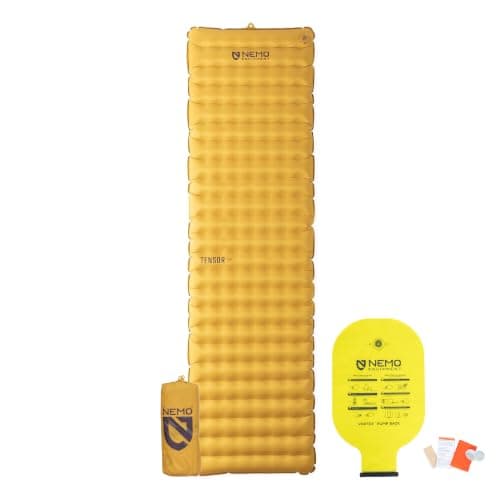
NEMO Tensor Trail (Regular)
395 g (13.9 oz)$150–$200 band9.2 / 10R-value 2.8 at 395 g and a full 3.5 in thick — the thickest here, which is what side sleepers notice. A summer and warm-three-season pad, not a cold-weather one.
$189.95Tensor Trail#ad · Price as of November 12, 2026 · Affiliate disclosure for the link to NEMO Tensor Trail (Regular)
Winter camping on frozen ground
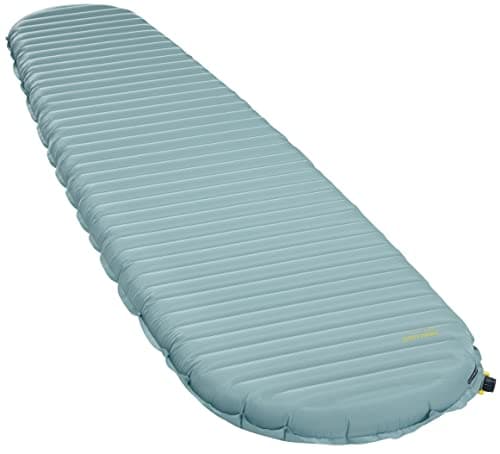
Therm-a-Rest NeoAir XTherm NXT (Regular)
440 g (15.5 oz)$200–$300 band9.2 / 10R-value 7.3 at 440 g: only 70 g more than the XLite for nearly twice the warmth, with a tougher 70D bottom. Overkill for July, and the right pad for frozen ground.
$208.00NeoAir XTherm NXT#ad · Price as of November 12, 2026 · Affiliate disclosure for the link to Therm-a-Rest NeoAir XTherm NXT (Regular)
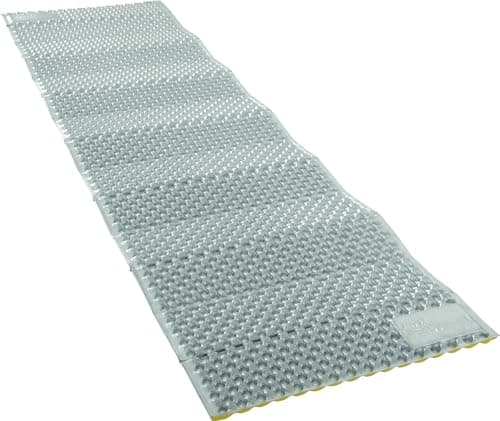
Unpoppable folding foam pad
Therm-a-Rest Z Lite SOL (Regular)
410 g (14.5 oz)$50–$100 band9.4 / 10R-value 2.0 at 410 g and 0.75 in thick, for a fraction of the price of any air pad. It cannot pop, it rides outside the pack, and it stacks under an air pad to add about 2.0 for winter.
$59.95Z Lite SOL#ad · Price as of November 12, 2026 · Affiliate disclosure for the link to Therm-a-Rest Z Lite SOL (Regular)
Photos are illustrative, not the product. Scores are spec-derived, on our published 8.4–9.8 scale.
Where each lands on our grams-per-dollar math, and the full field, is in the budget sleeping pad ranking. The cold-weather end has its own page in best sleeping pads for winter backpacking.
Four mistakes worth avoiding
Buying the bag first and the pad last. The order should be reversed. The pad sets the floor on how warm your sleep system can be, and no bag rating recovers a cold pad.
Comparing R-values from before the standard. Numbers published before ASTM F3340 were measured however each brand liked. If a listing shows an R-value with no standard named anywhere on the page, treat it as a marketing figure.
Buying a 20 in pad because it is standard. If you sleep on your side or move at night, rolling off the edge will cost you more sleep than any R-value decision. Try lying on one in a shop.
Leaving the pump sack at home. It weighs almost nothing, it is faster than lungs, and it keeps moisture out of the baffles. It is the easiest good habit in this whole guide.
How we scored this
How these picks were chosen
Every weight and list price here comes straight from the maker's own product page, measured against a named mainstream reference, then turned into one number: grams saved per dollar. Every figure links to the page it came from, so you can check any of it in a click.
Value and weight are computed from those published numbers; function, durability and ease are scored from the specs, manuals and standards each maker publishes. Commissions never set a score or decide a pick. The formula, weights and references are published.
What changed
- Published.
Questions
Frequently asked
What R-value do I need for a backpacking sleeping pad?
Is a foam pad lighter than an inflatable one?
How much should I spend on a sleeping pad?
Do I need a wide sleeping pad?
Can I use two sleeping pads together?
Why are some sleeping pads so noisy?
Receipts
Sources
- Therm-a-Rest (Cascade Designs): NeoAir XLite NXT product page (checked 2026-09-22)
- Therm-a-Rest (Cascade Designs): NeoAir XTherm NXT product page (checked 2026-09-22)
- Therm-a-Rest (Cascade Designs): Z Lite SOL product page (checked 2026-09-22)
- NEMO: Tensor Trail Insulated product page (checked 2026-09-22)
- ASTM F3340: standard test method for thermal resistance of camping mattresses
Weights, list prices and specs on this page come from each maker's own pages, linked on every product, and performance figures such as boil times or flow rates are the maker's claims, labeled that way, so you always know whose number you're reading. Amazon sets its own prices and changes them often, so buy buttons link to the live listing. Read the full method.