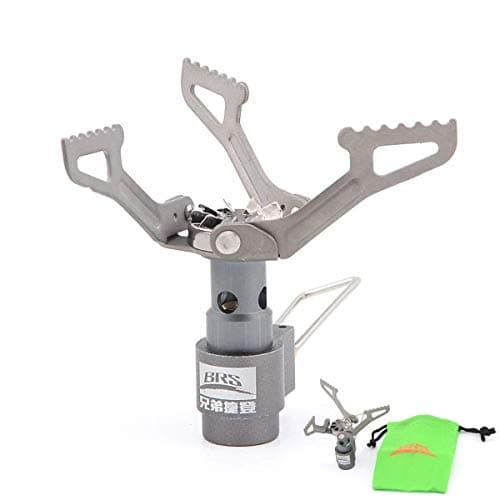
The contenders
Side by side
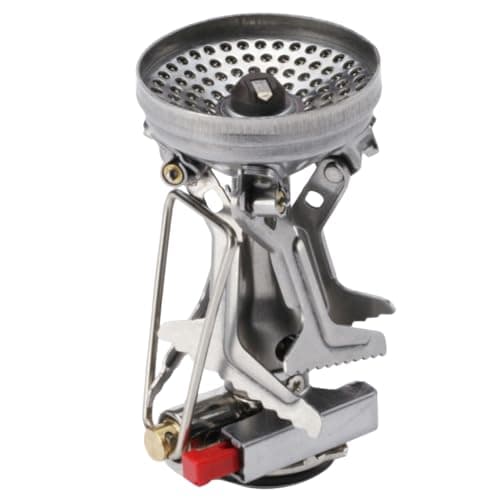
The convenience pick
SOTO Amicus Stove with Igniter
3.2 / 10A built-in igniter, a burner SOTO shapes for wind and the higher stated output, at the same list price as the PocketRocket 2 and 8 g more on the scale.
$64.95Amazon#ad · Price as of November 3, 2026 · Affiliate disclosure for the link to SOTO Amicus Stove with Igniter
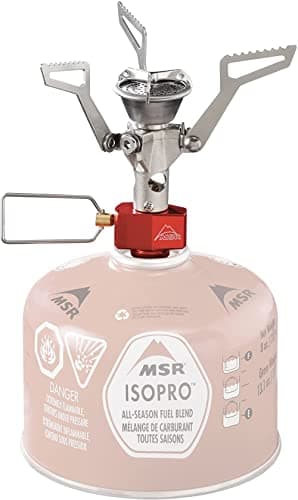
The documented pick
MSR PocketRocket 2
2.9 / 10Lighter by 8 g, with a published boil time, burn time and liters-boiled-per-canister figure, plus a hard case. No igniter, and no wind feature beyond the WindClip.
$49.04Amazon#ad · Price as of November 3, 2026 · Affiliate disclosure for the link to MSR PocketRocket 2
This is the closest pairing in the whole budget canister-stove field, and it is close for an unusual reason: the two makers chose the same number. SOTO lists the Amicus with igniter at $25–$50 MSRP band on its own product page and MSR lists the PocketRocket 2 at $25–$50 MSRP band on its own, so for once a comparison isn't really about money at all. It is about which features each company decided to put inside the same budget.
That also makes it a useful comparison for anyone shopping this site specifically. The PocketRocket 2 is the reference stove every canister stove here is measured against, so any stove that is heavier than it — the Amicus included — scores zero grams saved by definition. The question then stops being “which is lighter per dollar” and becomes the plainer one: at an identical price, which set of features do you actually want? For the full field, including two stoves that undercut both of these on weight and price, see our best budget backpacking stoves ranking.
Two stoves, one price
| Published spec | SOTO Amicus Stove with Igniter | MSR PocketRocket 2 |
|---|---|---|
| Weight | 81 g (2.9 oz) | 73 g (2.6 oz) |
| List price | $25–$50 band | $25–$50 band |
| Value | No grams saved vs the reference | No grams saved vs the reference |
| Output | 3,260 W / 2,800 kcal/h (SOTO lists 10,210 BTU) (as stated) | — |
| Boil time | — | 1 liter in 3.5 minutes (MSR IsoPro) (as stated) |
| Score | 3.2 / 10 | 2.9 / 10 |
Both stoves sit in the same MSRP band, so the value scores you see above are driven entirely by weight against the reference stove, not by any price difference. What each one actually sells for on Amazon on a given day is a separate number that moves, sometimes a long way from a maker's list price in either direction. The buy buttons on this page carry whatever the current figure is; we don't print a marketplace price in the copy, because by the time you read it, it may not be the price any more.
One practical consequence of that: if you are deciding between these two and one of them happens to be discounted when you look, the discount is a better tiebreaker than anything in the spec sheets below. The two stoves are close enough that a real price gap on the day should decide it.
Weight: 8 g apart
SOTO lists the Amicus at 81 g (2.9 oz) for the stove with its igniter. MSR lists the PocketRocket 2 at 73 g (2.6 oz) as a minimum weight, stove only. That is a gap of 8 g (0.3 oz) — roughly the weight of a single tent stake, and the smallest weight difference between any two stoves we compare head to head.
There is a wrinkle worth knowing, though, and it runs the other way. MSR's own page gives the PocketRocket 2 a packaged weight of 105 g with its hard-shell case included. SOTO does not list a separate packed weight for the Amicus, which ships in a soft stuff sack rather than a hard case. So if you carry the PocketRocket 2 in the case it comes with, the Amicus is the lighter thing in your pack; if you leave the case at home and nest the stove in a pot, the PocketRocket 2 keeps its 8 g advantage. Which number applies to you depends on a decision you make, not on the spec sheet.
Either way, 8 g is not a reason to pick a stove. If weight genuinely is your deciding factor, neither of these is the answer and the gap you should be looking at is far bigger: see our BRS-3000T vs MSR PocketRocket 2 comparison, where the weight difference is nearly three times over rather than eight grams.
The igniter question
This is the real difference between the two, and the one most buyers will feel. SOTO lists a built-in igniter on the Amicus, with what it calls a hidden electric line, meaning the wire runs inside the stove body rather than exposed down the side where it can snag or bend. MSR lists no igniter on the PocketRocket 2 at all; you light it with a lighter or matches, and you carry a backup for when the first one gets wet.
An igniter is a convenience feature, not a safety feature, and it is worth being clear-eyed about what it is and isn't. It saves you fumbling with a lighter in cold or wind, which is a genuine small pleasure at six in the morning. It is also one more thing that can stop working, and no maker guarantees a piezo igniter for the life of the stove. Anyone who relies on an igniter should carry a lighter anyway, which means the Amicus does not actually remove an item from your kit — it just means you reach for it less often.
Wind, output and boil claims
Both makers address wind, and both do it with burner geometry rather than a separate windscreen. SOTO describes a raised ledge at the burner crown plus a concave burner surface, which is its standard approach to keeping a flame seated in moving air. MSR fits what it calls a WindClip to the PocketRocket 2. Neither company publishes a wind-tunnel figure for these two stoves, so there is no number here to compare — only two different design claims.
On output, SOTO states 3,260 W (2,800 kcal/h, which SOTO also prints as 10,210 BTU) for the Amicus. MSR does not publish a watt or BTU figure for the PocketRocket 2 on its product page; it publishes a boil time instead, stating 1 liter in 3.5 minutes on its own IsoPro fuel. SOTO publishes no boil-time claim for the Amicus. So the two makers have each told you one half of the story and neither has told you the other half, which means the honest answer to “which boils faster” is that nobody has published the figures you would need to say.
Treat both numbers as what they are: manufacturer claims, measured by the manufacturer, under conditions the manufacturer chose. Every performance figure on this page is tagged as stated for exactly that reason. A higher stated wattage does not reliably mean a faster boil in your kitchen, let alone at 9,000 feet in a breeze, because output, pot shape, lid use, water temperature and wind all move the result.
Fuel planning
Here the PocketRocket 2 is clearly ahead, and not because it is a better stove: because MSR publishes more. MSR states roughly 60 minutes of burn time per 227 g IsoPro canister, 16 liters of water boiled from that canister, and 2 liters boiled per ounce of fuel. Those three figures are enough to provision a trip. SOTO states approximately 1.5 hours of burn time per 250 g canister for the Amicus and nothing about liters boiled, so you can estimate how long it will run but not how many dinners that is.
Both stoves thread onto the same standard isobutane-propane canisters, so fuel type is not a point of difference and any canister that fits one fits the other. If you are trying to work out how much fuel to carry for either stove, our how long does a fuel canister last guide works through the makers' published burn-time and liters-boiled numbers by canister size, and is explicit about which stoves publish them and which don't.
Pot supports and packed size
SOTO lists spring-loaded pot supports on the Amicus and gives it a stowed size of 4.3 x 4.0 x 7.5 cm, with an in-use footprint of 7.6 x 10.0 x 8.6 cm. MSR lists folding supports on the PocketRocket 2 and a packed size of 3.3 x 4.1 x 7.9 cm, and says the folded stove is small enough to fit inside an MSR Titan or Insulated Mug. Both are small enough to nest inside a solo pot with a fuel canister, which is how most people carry a canister stove anyway.
Neither maker publishes a maximum pot diameter for these two stoves, so if you cook for two out of a wide pot, you are buying on the drawings rather than on a stated limit. By contrast SOTO does publish a pot limit for its WindMaster with the included 4Flex support — 2 liters — which is one of the reasons that stove is the better group-cooking choice. Size your pot first and your stove second; our titanium pot rankings cover the solo and two-person sizes either of these stoves will sit under happily.
What neither stove has
Neither the Amicus nor the PocketRocket 2 has a pressure regulator. That matters more than the igniter does, and it is the single most important thing to understand before you buy either one. Without a regulator, the flame on a canister stove weakens as the canister empties and as the temperature drops, because both reduce the pressure inside the canister. In warm weather on a fresh canister you will never notice. On a frosty morning with a canister that is a third full, you will.
If your trips regularly see freezing nights, buy past both of these. SOTO's own answer is the WindMaster, which adds its Micro Regulator valve and an igniter at $50–$100 MSRP band and weighs 87 g (3.1 oz) with the included 4Flex support. MSR's answer is the PocketRocket Deluxe, which adds a regulator and a piezo igniter at $50–$100 MSRP band and 83 g (2.9 oz). Both are a genuine step up in capability rather than a trim level, and both are ranked in our budget stove rankings.
Neither stove includes fuel, and neither includes a pot. Whichever you choose, your first trip needs a canister and something to boil water in, and the pot is the bigger decision of the two for both weight and fuel use.
What we can't tell you
We can't tell you which of these two lights more reliably after a season of use, because neither maker publishes a durability figure or a cycle count for an igniter, and we rank gear on published specifications rather than on use. If long-term igniter reliability is your deciding factor, that is a question the spec sheets cannot answer and neither can we.
We also can't compare boil times directly, for the reason above: MSR publishes one for the PocketRocket 2 and SOTO publishes none for the Amicus. Anyone quoting you a precise Amicus boil time is estimating, not citing SOTO. And we can't tell you how either stove behaves in a specific wind speed, because neither maker states one.
What we can tell you is what each company was willing to put its name to, which is most of what this comparison is. On that evidence MSR documents the PocketRocket 2 more thoroughly than SOTO documents the Amicus, and SOTO gives the Amicus more hardware for the same money. Both of those are real facts about the purchase.
Who should buy which
At an identical list price, there is no bad choice here, only a mismatched one. Pick from how you cook:
- First stove, three-season trips, you just want it to work: the SOTO Amicus. The igniter is free at this price and the stove is otherwise the PocketRocket 2's equal on everything that matters to a weekend hiker. The 8 g you pay for it is noise.
- You plan fuel carefully, or you are counting grams: the MSR PocketRocket 2. It is the lighter stove and the only one of the two with a published liters-boiled-per-canister figure, so it is the one you can actually provision a long trip around.
- You already own a hard-case habit, or nest your stove in a pot: the PocketRocket 2, whose case is included and whose folded size MSR states will fit inside its own mugs. Leave the case home and you keep the weight advantage too.
- Cold mornings, shoulder season, or cooking off part-empty canisters: neither. Buy a regulated stove — the SOTO WindMaster or the MSR PocketRocket Deluxe — and treat the extra cost as buying performance, not convenience.
- Cooking for two or three out of a big pot: the SOTO WindMaster, because it is the only stove in this group whose maker publishes a maximum pot size for the support it ships with.
- Absolute lowest weight, and price is barely a constraint in the other direction: neither. See our stove rankings for the titanium flyweights, and read canister vs alcohol stoves first if you haven't settled on a fuel type at all.
Running either stove safely
Both makers sell a regulated stove a tier above these two, and they are compared on SOTO WindMaster vs MSR PocketRocket Deluxe.
In detail
The contenders, in full
The convenience pick
SOTO Amicus Stove with Igniter
A built-in igniter, a burner SOTO shapes for wind and the higher stated output, at the same list price as the PocketRocket 2 and 8 g more on the scale.
Published specsFrom the maker, with the source linked
| Weight | 81 g (2.9 oz) (listed weight, stove with igniter) |
|---|---|
| List price | $25–$50 MSRP band (per sotooutdoors.com, checked Sep 2026) |
| Value | No grams saved vs the referencevs the reference MSR PocketRocket 2 at 73 g (2.6 oz) |
| Output | 3,260 W / 2,800 kcal/h (SOTO lists 10,210 BTU)As stated |
| Burn time | Approx. 1.5 hours per 8 oz (250 g) canisterAs stated |
| Igniter | Built-in, with a hidden electric line |
| Wind handling | Raised ledge at the burner crown plus a concave burner surface for windy conditions |
| Pot supports | Spring-loaded |
| Size | In use 7.6 x 10.0 x 8.6 cm; stowed 4.3 x 4.0 x 7.5 cm |
How the 3.2 score breaks down
- Grams per dollar (35%, computed)
- 0.0
- Weight (20%, computed)
- 0.0
- Output & wind handling (25%)
- 7.0
- Materials & durability (10%)
- 6.0
- Ease & versatility (10%)
- 8.0
What the specs support
- Built-in igniter at the same MSRP as the PocketRocket 2.
- Burner head shaped for wind: a raised crown ledge and a concave surface, per SOTO.
- SOTO lists 3,260 W of output.
Where it falls short
- No pressure regulator is listed.
- 81 g (2.9 oz) is 8 g heavier than the reference stove, so it scores zero grams saved.
Skip it if…
Skip it if you cook in sub-freezing temperatures: SOTO lists no pressure regulator on the Amicus, so the WindMaster is the SOTO to buy for cold trips.
#ad · Price as of November 3, 2026 · Affiliate disclosure for the link to SOTO Amicus Stove with Igniter
The documented pick
MSR PocketRocket 2
Lighter by 8 g, with a published boil time, burn time and liters-boiled-per-canister figure, plus a hard case. No igniter, and no wind feature beyond the WindClip.
Published specsFrom the maker, with the source linked
| Weight | 73 g (2.6 oz) (minimum weight, stove only (packaged weight with the hard-shell case is 105 g)) |
|---|---|
| List price | $25–$50 MSRP band (per cascadedesigns.com, checked Sep 2026) |
| Value | No grams saved vs the referencevs the reference MSR PocketRocket 2 at 73 g (2.6 oz) |
| Boil time | 1 liter in 3.5 minutes (MSR IsoPro)As stated |
| Burn time | Approx. 60 minutes per 227 g (8 oz) IsoPro canisterAs stated |
| Water boiled | 16 liters per 227 g canister; 2 liters per 1 oz of fuel (MSR IsoPro)As stated |
| Wind / supports | WindClip wind protection; folding pot supports |
| Packed size | 3.3 x 4.1 x 7.9 cm (1.3 x 1.6 x 3.1 in) |
| Packaged weight | 105 g (3.7 oz) with the hard-shell carry case |
How the 2.9 score breaks down
- Grams per dollar (35%, computed)
- 0.0
- Weight (20%, computed)
- 0.0
- Output & wind handling (25%)
- 6.0
- Materials & durability (10%)
- 7.0
- Ease & versatility (10%)
- 7.0
What the specs support
- MSR states a 1-liter boil in 3.5 minutes and 16 liters boiled per 227 g canister.
- Folding supports pack small enough to fit in an MSR Titan or Insulated Mug, per MSR.
- Hard-shell carry case included.
Where it falls short
- No igniter or pressure regulator is listed (the PocketRocket Deluxe adds both).
- At 73 g (2.6 oz) it is nearly three times the BRS-3000T's stated 25 g (0.9 oz).
Skip it if…
Skip it if you cook below freezing or on part-empty canisters often: MSR lists no pressure regulator on the PocketRocket 2 and puts one on the Deluxe instead.
#ad · Price as of November 3, 2026 · Affiliate disclosure for the link to MSR PocketRocket 2
How we scored this
How these picks were chosen
Every weight and list price here comes straight from the maker's own product page, measured against a named mainstream reference, then turned into one number: grams saved per dollar. Every figure links to the page it came from, so you can check any of it in a click.
Value and weight are computed from those published numbers; function, durability and ease are scored from the specs, manuals and standards each maker publishes. Commissions never set a score or decide a pick. The formula, weights and references are published.
Questions
Frequently asked
Is the SOTO Amicus better than the MSR PocketRocket 2?
How much heavier is the SOTO Amicus than the PocketRocket 2?
Does the SOTO Amicus have a pressure regulator?
Which stove boils water faster?
Is the Amicus igniter reliable?
Do these stoves use the same fuel canisters?
Which stove should a first-time backpacker buy?
Receipts
Sources
- SOTO: Amicus Stove with Igniter product page (checked 2026-09-22)
- MSR (Cascade Designs): PocketRocket 2 Stove product page (checked 2026-09-22)
- SOTO: WindMaster Stove with 4Flex product page (checked 2026-09-26)
- MSR (Cascade Designs): PocketRocket Deluxe Stove product page (checked 2026-09-22)
- Smokey Bear (USDA Forest Service / Ad Council): campfire safety guidance (checked 2026-10-09)
Weights, list prices and specs on this page come from each maker's own pages, linked on every product, and performance figures such as boil times or flow rates are the maker's claims, labeled that way, so you always know whose number you're reading. Amazon sets its own prices and changes them often, so buy buttons link to the live listing. Read the full method.