There are two materials in backpacking cookware that matter and one that does not. Titanium and hard-anodised aluminum are the real choice; stainless steel is durable, cheap and far too heavy to carry for fun. The usual summary — titanium is lighter, aluminum cooks better — is correct and incomplete, because the size of each effect is what decides the purchase.
The weights, side by side
Every figure below is the maker's own published weight, with lids where the maker includes one. The reference this site measures cook pots against is the MSR Trail Lite 1.3 L Pot at 200 g (7.1 oz), a mainstream aluminum pot.
| Pot | Material | Capacity | Weight |
|---|---|---|---|
| TOAKS 550 ml (POT-550-L) | Grade 1 titanium, 0.3 mm | 550 ml | 72 g with lid |
| TOAKS 750 ml (POT-750) | Titanium | 750 ml | 103 g with lid |
| TOAKS 1100 ml (POT-1100) | Titanium | 1,100 ml | 125 g |
| MSR Titan Kettle | Titanium | 900 ml | 130 g |
| Fire Maple Petrel G3 HX | Aluminum alloy + heat exchanger | 600 ml | 162 g |
| Fire Maple Petrel G2 | Hard-anodised aluminum + heat exchanger | 750 ml | 184 g |
The honest comparison is the two 750 ml pots: titanium at 103 g (3.6 oz) against aluminum at 184 g (6.5 oz). That is 81 g (2.9 oz) for the same capacity, and the aluminum pot has a heat exchanger bonded to its base, which is part of the difference. Titanium is genuinely the lighter metal, but a bare aluminum pot of the same thickness is closer than this table suggests — the gap you see here is titanium's 0.3 mm walls against aluminum plus a heat-exchanger ring.
How each metal handles heat
So the material question collapses into a behavior question: do you boil, or do you cook? If every meal is a freeze-dried pouch and a hot drink, you are boiling, and titanium's weakness never appears. Our meals page and cold soaking guide both assume a boil-only kitchen, which is what most ultralight hikers run.
Four pots worth buying
Two titanium, two aluminum, at the two sizes that cover solo cooking. Picked to make the trade-off visible rather than to rank them.
Our picks for this
Two titanium, two aluminum
Every weight and capacity is the maker's own published figure. The full ranking of titanium pots is linked below.
Best solo titanium pot
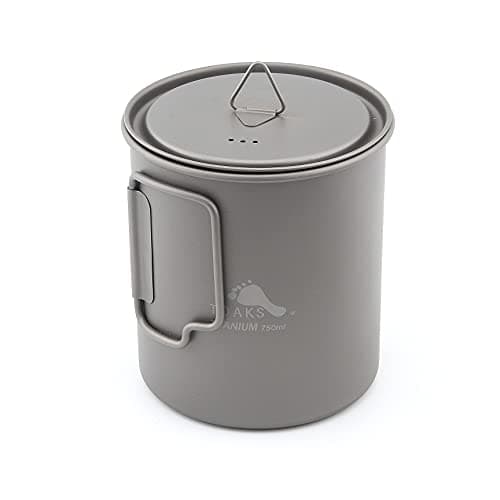
TOAKS Titanium 750ml Pot (POT-750)
103 g (3.6 oz)$25–$50 band7.6 / 10The solo default: 103 g with lid, holds a 110 g canister and a compact stove, and the lowest list price of the titanium pots we track.
$26.00Amazon#ad · Price as of November 3, 2026 · Affiliate disclosure for the link to TOAKS Titanium 750ml Pot (POT-750)
Lightest pot for boil-only solo trips
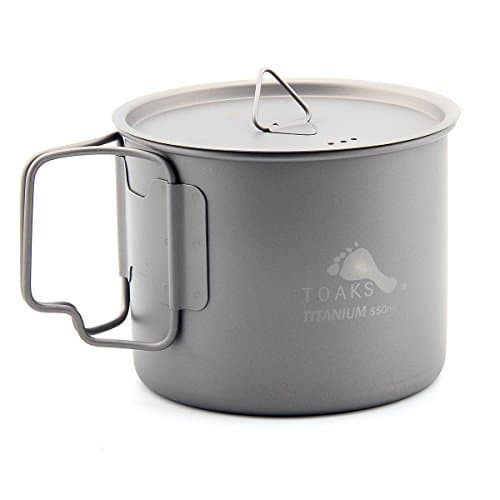
TOAKS Ultralight Titanium 550ml Pot (POT-550-L)
72 g (2.5 oz)$25–$50 band7.6 / 1072 g with lid and 0.3 mm walls: the lightest real pot here, and the right answer if you only ever boil 500 ml for one.
$29.95Amazon#ad · Price as of November 3, 2026 · Affiliate disclosure for the link to TOAKS Ultralight Titanium 550ml Pot (POT-550-L)
Budget heat-exchanger pot for one
Fire Maple Petrel G3 600ml HX Pot
162 g (5.7 oz)$25–$50 band4.7 / 10The cheapest route to a heat exchanger: 162 g of aluminum with an integrated HX ring, and a 110 g canister fits inside with the lid closed.
Check price · Amazon#ad · Price as of November 3, 2026 · Affiliate disclosure for the link to Fire Maple Petrel G3 600ml HX Pot
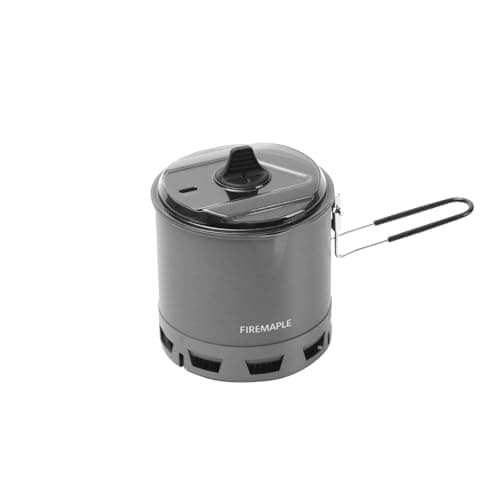
Fuel-saving pot that fits a 230 g canister
Fire Maple Petrel G2 750ml Pot
184 g (6.5 oz)$25–$50 band4.0 / 10184 g of hard-anodised aluminum with an HX ring and a 750 ml capacity that swallows a 230 g canister; the pot to buy if you actually cook.
Check price · Amazon#ad · Price as of November 3, 2026 · Affiliate disclosure for the link to Fire Maple Petrel G2 750ml Pot
Photos are illustrative, not the product. Scores are spec-derived.
The heat exchanger argument
A heat exchanger is a ring of corrugated metal fins bonded to the base of the pot, which catches flame and hot gas that would otherwise escape up the sides. Fire Maple states that the Petrel's integrated exchanger directs more burner heat into the pot for faster boiling and better fuel efficiency. That is a maker claim, and it is the standard claim across the category.
Two things follow. First, you cannot have one in titanium: heat exchangers are bonded aluminum constructions, and this is the one capability titanium simply does not offer. Second, the weight maths changes on a long trip. A pot that uses less fuel means a smaller canister, and fuel is consumable weight you carry from the start.
Roughly: the Petrel G2 is 81 g (2.9 oz) heavier than the TOAKS 750, and a 110 g canister is about 200 g all-in against about 370 g for a 230 g canister. If a heat exchanger lets you carry the smaller canister on a trip where you would otherwise need the bigger one, the aluminum pot wins outright on carried weight. On a weekend with one canister either way, titanium wins. Our fuel canister guide has the arithmetic for working out which case you are in.
Durability, coatings and taste
- Dents. Titanium is stronger per gram, but ultralight titanium pots are 0.3 mm thick, so both materials dent if you sit on them. Neither is fragile in normal use.
- Coatings. Titanium pots are typically uncoated bare metal, which means nothing to flake and nothing to baby. Hard-anodised aluminum has a hardened surface layer; some aluminum pots add non-stick, which is the layer most likely to fail over years of scrubbing.
- Cleaning. Aluminum is easier to clean because food is less likely to weld itself to a hot spot in the first place. On titanium, add water and let it soak rather than scraping.
- Taste. Bare titanium is inert and tasteless, which is one reason coffee drinkers like it. Bare aluminum can impart a metallic edge, which is why cookware is anodised.
- Nesting. This matters more than material. The TOAKS 750 holds a 110 g canister and a PocketRocket 2; the Petrel G2 holds a 230 g canister; the MSR Titan Kettle holds an 8 oz canister or a 4 oz canister plus a stove. Buy the pot that packs your stove.
What each costs per gram saved
Against the MSR Trail Lite 1.3 L Pot reference, the titanium pots do what you would expect: the TOAKS 750 saves 97 g (3.4 oz) vs the MSR Trail Lite 1.3 L Pot and the TOAKS 550 saves 128 g (4.5 oz) vs the MSR Trail Lite 1.3 L Pot. The aluminum pots save less: the Petrel G3 saves 38 g (1.3 oz) vs the MSR Trail Lite 1.3 L Pot and the Petrel G2 saves 16 g (0.6 oz) vs the MSR Trail Lite 1.3 L Pot.
What is interesting is the price. Titanium carries a reputation as the expensive metal, and at the solo sizes that is not true any more: the TOAKS 750 lists below both Petrels, and well below the MSR Titan Kettle at 130 g (4.6 oz), which is the one genuinely premium pot on this page. Paying more for titanium buys you a pour spout, graduation marks and silicone handles rather than a lighter pot. The ranked titanium field is on best titanium backpacking pots.
Which one to buy
Buy titanium if: you boil water and rehydrate; you want the lightest possible kitchen; you drink a lot of coffee and dislike metallic taste; you want a pot that nests your canister and stove and nothing else. The TOAKS 750 at 103 g (3.6 oz) is the default, and the 550 at 72 g (2.5 oz) if you only ever boil for one.
Buy aluminum if: you simmer, fry or cook from raw ingredients; you are on a long trip where fuel weight compounds; you cook for two and want the bigger pot to behave itself; you want the lowest possible price with a heat exchanger. The Petrel G3 at 162 g (5.7 oz) is the cheap route in, the G2 at 184 g (6.5 oz) the bigger one.
Buy neither if you are not sure you want a stove at all. A cold-soak jar weighs almost nothing and costs nothing — the honest case for and against is in our cold soaking guide. And if you have not chosen a stove yet, pick the pot second: see best budget backpacking stoves and stove systems, where the pot and burner come matched.
One pot covers almost everyone. If you cook for two regularly, the TOAKS 1100 at 125 g (4.4 oz) is the titanium answer, and it is only 22 g (0.8 oz) more than the solo pot.
Cooking for two changes the calculation again, because capacity and base diameter start to matter more than material: best backpacking pots for two people ranks the pots that hold 750 ml or more.
How we scored this
How these picks were chosen
Every weight and list price here comes straight from the maker's own product page, measured against a named mainstream reference, then turned into one number: grams saved per dollar. Every figure links to the page it came from, so you can check any of it in a click.
Value and weight are computed from those published numbers; function, durability and ease are scored from the specs, manuals and standards each maker publishes. Commissions never set a score or decide a pick. The formula, weights and references are published.
What changed
- Published.
Questions
Frequently asked
Is titanium or aluminum better for backpacking cookware?
How much lighter is a titanium pot?
Does food burn in a titanium pot?
Is a heat exchanger pot worth the extra weight?
Is titanium cookware more expensive than aluminum?
Receipts
Sources
- TOAKS: Titanium 750 ml Pot (POT-750) product page (checked 2026-09-22)
- TOAKS: Ultralight Titanium 550 ml Pot (POT-550-L) product page (checked 2026-09-22)
- TOAKS: Titanium 1100 ml Pot (POT-1100) product page (checked 2026-09-22)
- Fire Maple: Petrel G3 600 ml Ultralight Pot product page (checked 2026-09-22)
- Fire Maple: Petrel G2 750 ml Ultralight Pot product page (checked 2026-09-22)
- MSR: Titan Kettle 900 ml product page (checked 2026-09-22)
Weights, list prices and specs on this page come from each maker's own pages, linked on every product, and performance figures such as boil times or flow rates are the maker's claims, labeled that way, so you always know whose number you're reading. Amazon sets its own prices and changes them often, so buy buttons link to the live listing. Read the full method.