“Why are ultralight tents so expensive” usually gets answered with one word: Dyneema. That answer is a third of the truth. Premium fabric is genuinely expensive, and we can show you exactly how expensive with published prices. But fabric alone does not explain why one two-person shelter sits in the $150–$200 MSRP band while another sits in the $700+ MSRP band, because a tent is only a few yards of cloth either way. The rest of the gap is labor, scale, distribution and finishing work, and each of those is something you can actually evaluate before you spend.
This page walks the cost stack from the raw material up. Every figure is either a published price we link to or a number computed from one. If you want the fabric properties themselves rather than their cost, read silnylon vs silpoly vs Dyneema first; this page is about the money.
1. The fabric bill per yard
Start with the one input anyone can price, because shelter fabric is sold by the yard to the public. Ripstop by the Roll, the largest US retailer of maker-grade shelter fabric, publishes a price for all three materials a tent in this category might be cut from: 1.1 oz silnylon, 1.1 oz Silpoly PU4000 (rated to roughly 4,000 mm hydrostatic head), and Dyneema Composite Fabric in the 0.8 oz weight (CT2E.08), which it sells by the half yard rather than the yard. Every figure below is computed from those three listed prices, all linked in the sources at the foot of this page.
Those are retail prices paid by a hobbyist buying a yard at a time, and no manufacturer pays retail. But the ratio between the fabrics is the useful part, and it holds: the premium material is a multiple of the budget material, not a few percent more. That is why the lightest shelters on the market are also, without exception, the most expensive ones, and why a brand cannot simply decide to sell a Dyneema tent at a silnylon price.
What fabric alone does not explain
Here is the part most explanations skip. A two-person trekking-pole shelter is not a large object. Even generously, a canopy, floor and reinforcements come to a handful of yards of cloth. Multiply a handful of yards by that per-yard gap and the material-cost difference lands in the tens of dollars, not the hundreds. The $700+ MSRP band that a Dyneema shelter like the Zpacks Duplex sits in is several bands above the $150–$200 MSRP band of a silnylon tent like the Lanshan 2, and fabric is not carrying that gap on its own.
We are deliberately not going to invent a yardage figure for you. No tent maker publishes how many yards of cloth goes into its shelters, so any “a Duplex contains X yards” number you see online is someone's estimate dressed up as a fact. What we can say with confidence is the direction: the fabric gap is real but it is too small to be the whole answer. The next three sections are where the rest of the money goes.
2. Who sews it, and how many
This is the single biggest driver, and it is the one buyers think about least. The lightest shelters are generally made by small Western companies in their own workshops. Zpacks states plainly that its gear is “all sewn in our facility in West Melbourne, FL USA.” The company's own history page describes founder Joe Valesko starting out at “a sewing machine in his apartment” and “producing them at night and on weekends.” That is the origin story of most of the cottage ultralight industry, and the economics it implies never fully go away: domestic labor rates, small production runs, and no ability to amortize setup costs over a hundred thousand units.
Contrast that with how a tent gets built when volume is the goal. Durston says the X-Mid 2 “is built at the most experienced premium tent factory in the world who have been building nothing but tents for nearly 70 years.” A dedicated high-volume factory can hold tight tolerances at a cost per unit a small workshop cannot match, which is a large part of why the X-Mid 2 lands in the $300–$400 MSRP band while weighing 890 g (1 lb 15.4 oz) — only 385 g (13.6 oz) more than the Duplex's 505 g (1 lb 1.8 oz).
Budget brands sit further along the same curve again: larger runs, lower labor costs, and fabrics bought at volume. That is the structural reason a tent like the Lanshan 2 can be genuinely light at a genuinely low price, and it is also why its finish work is where the compromises show up — which is section four.
3. Retail markup versus selling direct
A tent that passes through a distributor and a retailer has to support both of their margins, and that markup is applied to the manufacturer's price rather than added as a flat fee. Durston is unusually direct about this on its own product page: “This focus on quality gives the X-Mid 2 a higher cost of production than competing tents, yet the X-Mid 2 is priced affordably. This is possible because we sell directly to you with no retailer markup and only a modest markup ourselves.” Its philosophy page makes the same point about the relationship: “We have a close connection to all our customers because we sell directly to them instead of through retailers.”
Read that carefully, because it cuts against the usual assumption. Durston is telling you that the X-Mid 2 costs more to make than tents it competes with, and that the only reason the price does not reflect that is the absence of a retail layer. Which means some of what you pay for a mainstream brand-name tent on a shop shelf is not the tent at all. It also means a direct-only brand can be the better value even when its sticker looks high, and that a tent you can only buy from the maker's own site is not automatically overpriced. The X-Mid 2 is exactly that case: it is not sold on Amazon, so its buy button here goes to Durston.
4. Seams, warranty and the invisible work
The last slice of the price is finishing work you cannot see in a product photo, and this is where budget tents genuinely give something up.
Seam sealing. Durston states that on the X-Mid 2, “our seams are factory waterproofed so user seam sealing is not required,” using “a mix of seam taping and proprietary waterproof seam technology.” The standard Lanshan 2 is also factory taped. But the lighter Lanshan 2 Pro is not: 3F UL Gear states its silicone-on-both-sides fabric cannot be factory-taped and has to be sealed by the buyer before use. That is an hour or two of work with a bottle of sealant, transferred from the factory to your kitchen table. It is a real cost; it is just paid in your time instead of your money.
Warranty. Durston publishes a 2-year warranty on the X-Mid 2. Neither 3F UL Gear page we cite publishes a warranty term for the Lanshan 2 or the Lanshan 2 Pro. A stated warranty is a liability the maker has priced into the tent, and the absence of one is a cost that moves to you if a seam fails in year two.
Why the last 300 grams cost the most
Stack those four drivers and you get the shape that governs this entire category: the first big weight saving is cheap, and every one after it costs more than the last.
Watch it happen against Kelty Late Start 2P, the mainstream two-person tent this site measures value against, at 1,900 g (4 lb 3.0 oz). The Lanshan 2 weighs 1,060 g (2 lb 5.4 oz) and saves 840 g (1 lb 13.6 oz) vs the Kelty Late Start 2P — most of the available saving, from the $150–$200 MSRP band. The Lanshan 2 Pro trims a further 158 g (5.6 oz) and asks you to seal the seams yourself. The X-Mid 2 at 890 g (1 lb 15.4 oz) costs a higher MSRP band and buys back the factory seams, a wider floor and the warranty. Only at the top does the Duplex reach 505 g (1 lb 1.8 oz), and it takes the $700+ MSRP band to get there.
The computed value scores tell the same story more bluntly. On grams saved per dollar, the Lanshan 2 scores Value 7.7/10, the X-Mid 2 Value 4.5/10 and the Duplex Value 2.7/10. The Duplex is not a worse tent — it is the lightest two-person shelter we track, and it is in stock and sold by a maker who sews it in-house. It is simply the most expensive way to buy a gram, which is the honest thing to say about it. Full scoring rules are on our methodology page.
Our picks for this
Three places to stop on the price curve
The same job (a two-person, two-door, trekking-pole shelter) at three points on the cost stack above, so you can pick where paying more stops being worth it to you.
Budget double-wall trekking-pole tent for 2
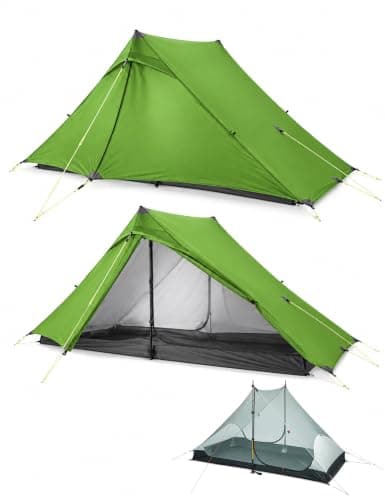
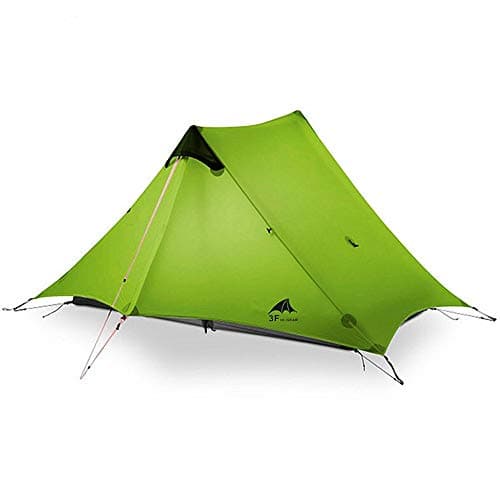
3F UL Gear Lanshan 2
1,060 g (2 lb 5.4 oz)$150–$200 band7.0 / 10Most of the weight saving for the least money, with factory-taped seams already done.
$187.88Amazon#ad · Price as of November 3, 2026 · Affiliate disclosure for the link to 3F UL Gear Lanshan 2

Best double-wall trekking-pole tent for two
Durston X-Mid 2
890 g (1 lb 15.4 oz)$300–$400 band6.7 / 10Where paying more is defensible: factory-sealed seams, a stated 2-year warranty, sold direct.
Not sold on Amazon. Sold direct by Durston Gear; we have no affiliate relationship with them, so there is no buy link here.
Specs on this page are cited from Durston Gear's own product page.
Premium Dyneema benchmark for two
Zpacks Duplex
505 g (1 lb 1.8 oz)$700+ band6.1 / 10The lightest two-person shelter we track, and the most expensive way to buy a gram. Buy it for the weight, not the value.
Not sold on Amazon. Sold direct by Zpacks; we have no affiliate relationship with them, so there is no buy link here.
Specs on this page are cited from Zpacks's own product page.
Photos are illustrative, not the product. Scores are spec-derived.
Where a value buyer should stop paying
Our standing answer for this site's reader is the budget trekking-pole tier, and the cost stack above is why. Three of the four price drivers — small-batch labor, retail markup and premium fabric — buy you weight you can mostly get another way. The fourth, finishing work, is the one worth paying for, because factory-sealed seams and a published warranty are not things you can add later for free.
So the practical rule: pay up for a tent whose seams come sealed and whose maker publishes a warranty, and stop paying before you reach the fabric tier. If you want the full ranked field at that level, start with best budget backpacking tents, or best ultralight tents under $200 if your ceiling is a hard number. For the two tents in this comparison head to head, see Lanshan 2 vs Durston X-Mid 2.
And if a mainstream tent is what you can afford right now, that is a defensible choice too. The reference tent above is a perfectly serviceable shelter; it is just heavier than it needs to be. Our how much should a backpacking tent weigh guide shows what that costs you in grams, and how to lower your base weight covers the cheaper places to find the same weight elsewhere in your kit. Jumping several price bands on a tent to save 300 g is a worse deal than fixing an overweight pack or sleeping bag first, which is usually where the easy grams are.
What we can't tell you
- How many yards of fabric any specific tent uses. No maker publishes it, so we will not convert the per-yard prices above into a per-tent material cost.
- What manufacturers actually pay for fabric. The prices we cite are public retail prices from a fabric shop. Wholesale rates are not published; only the ratio between fabrics is usable.
- Each company's margin. Durston states it takes “only a modest markup”; no brand here publishes actual margin figures, and we are not going to guess at them.
- Whether a premium tent lasts longer. We do not run durability tests. Published warranty terms are the closest thing to evidence on this page, and they are a claim about liability, not a measured lifespan.
The clearest single example of this price curve is X-Mid 2 vs Zpacks Duplex: two premium trekking-pole tents, 385 g apart, with one listing at more than twice the other.
How we scored this
How these picks were chosen
Every weight and list price here comes straight from the maker's own product page, measured against a named mainstream reference, then turned into one number: grams saved per dollar. Every figure links to the page it came from, so you can check any of it in a click.
Value and weight are computed from those published numbers; function, durability and ease are scored from the specs, manuals and standards each maker publishes. Commissions never set a score or decide a pick. The formula, weights and references are published.
What changed
- Published.
Questions
Frequently asked
Why are ultralight tents so expensive?
Four stacked reasons: on published fabric-shop prices, Dyneema Composite Fabric costs more than four times as much per yard as silnylon; the lightest tents are sewn in small Western workshops rather than high-volume factories; tents sold through retailers carry a retail markup on top of the maker's price; and finishing work like factory-sealed seams and a stated warranty costs money to provide.
Is Dyneema really worth four times the price of silnylon?
Per yard of fabric, you pay roughly four times as much for cloth that is about 27% lighter, by the published 0.8 oz/yd² and 1.1 oz/yd² figures. Whether that trade is worth it depends entirely on how much the weight matters to you. For most budget buyers it is not, which is why our top picks are silnylon and silpoly tents rather than Dyneema ones. See silnylon vs silpoly vs Dyneema for what each fabric does differently beyond weight.
Are cheap ultralight tents actually any good?
On headline weight and published waterproof ratings, the budget tier holds up well — the Lanshan 2 weighs 1,060 g (2 lb 5.4 oz) and saves 840 g (1 lb 13.6 oz) vs the Kelty Late Start 2P. Where budget tents give something up is the finishing work: seam sealing you may have to do yourself, no published warranty term, and less consistency between units. See the ranked field in best budget backpacking tents.
Why is a tent sold only by the maker cheaper than one in a shop?
Because there is no retail layer to pay for. Durston states the X-Mid 2 has “a higher cost of production than competing tents” yet stays affordable “because we sell directly to you with no retailer markup and only a modest markup ourselves.” A direct-only tent is not automatically overpriced, and sometimes the opposite.
What should I pay for a first ultralight tent?
Our answer is the budget trekking-pole tier, buying the cheapest tent whose seams come factory sealed and whose maker publishes a warranty term. That gets most of the available weight saving while keeping the one cost that is genuinely hard to add later. See best ultralight tents under $200 for the field at that level.
Do expensive tents last longer?
We can't verify that, and we won't claim it. We don't run durability tests. The only published evidence on this page is warranty length — Durston states 2 years on the X-Mid 2, while the 3F UL Gear pages we cite publish no term — and a warranty is a statement about liability, not a measured lifespan.
Is a heavier mainstream tent ever the smarter buy?
Yes, if the weight gap doesn't change your trips, or if the money is better spent elsewhere in your kit. Paying several hundred dollars extra to save a few hundred grams off an already-light tent is a worse deal than fixing an overweight pack or sleeping bag first. See how to lower your base weight.
Receipts
Sources
- Ripstop by the Roll: 1.1 oz Silnylon, $10.50/yd (checked 2026-10-01)
- Ripstop by the Roll: 1.1 oz Silpoly PU4000, $13.75/yd, ~4000 mm HH (checked 2026-10-01)
- Ripstop by the Roll: 0.8 oz Dyneema Composite Fabric CT2E.08, $23.00/half yd, 0.8 oz/yd2 (27.1 gsm) (checked 2026-10-01)
- Zpacks: About Us / the Zpacks team, "all sewn in our facility in West Melbourne, FL USA" (checked 2026-10-01)
- Zpacks: Duplex Classic Tent product page (checked 2026-10-01)
- Durston Gear: X-Mid 2 product page, production cost, retailer markup, factory, warranty and seam statements (checked 2026-10-01)
- Durston Gear: Philosophy page, selling direct to customers (checked 2026-10-01)
- 3F UL Gear: Lanshan 2 product page (checked 2026-10-01)
- 3F UL Gear: Lanshan 2 Pro product page, seam-sealing statement (checked 2026-10-01)
- Kelty: Late Start 2P Tent product page (checked 2026-10-01)
Weights, list prices and specs on this page come from each maker's own pages, linked on every product, and performance figures such as boil times or flow rates are the maker's claims, labeled that way, so you always know whose number you're reading. Amazon sets its own prices and changes them often, so buy buttons link to the live listing. Read the full method.