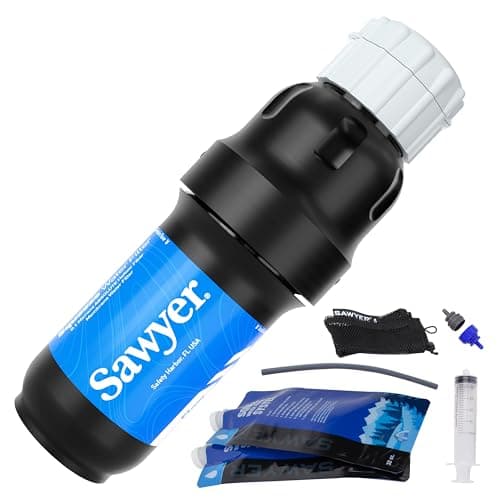
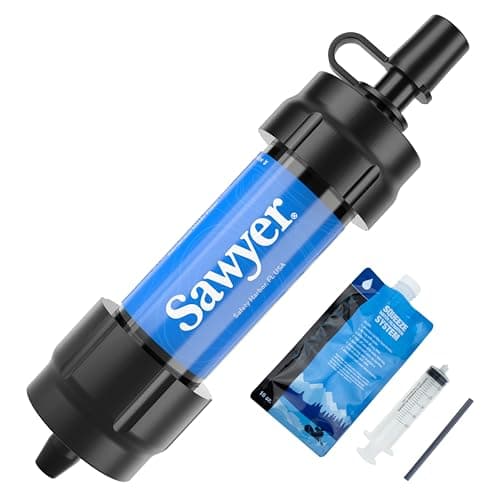
Quick picks
The picks at a glance
| # | Product | Best for | Score | Price |
|---|---|---|---|---|
| 1 | 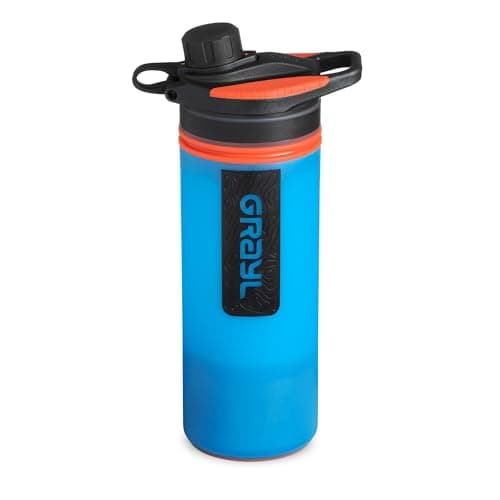 GRAYL GeoPress 24 oz Purifier 710 ml of virus-rated water per press in 8 seconds, tested against NSF/ANSI 42 and 53 and the EPA purifier standard, with nothing to backflush. | Best water purifier overall450 g (15.9 oz)$50–$100 band | 3.7 / 10No grams saved vs the reference | $99.95Amazon #ad · Disclosure |
| 2 | 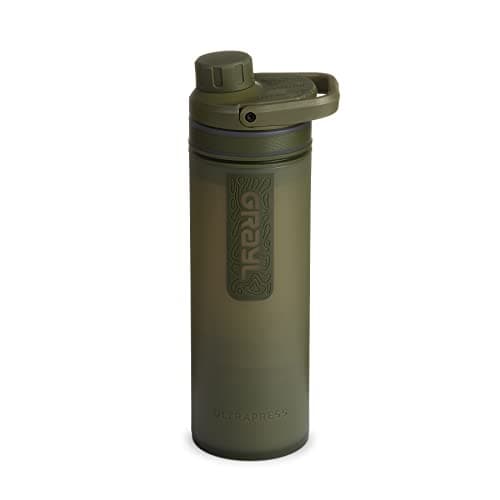 GRAYL UltraPress 16.9 oz Purifier The same virus, bacteria and protozoa claims in a 354 g bottle, at the cost of a 150 L rated cartridge life. | Lightest purifier here354 g (12.5 oz)$50–$100 band | 3.5 / 10No grams saved vs the reference | $89.95Amazon #ad · Disclosure |
| 3 | 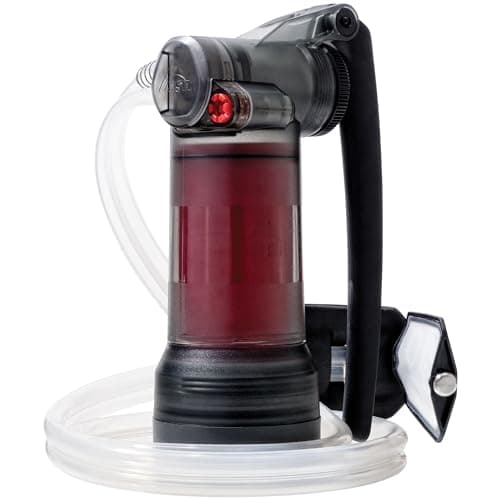 MSR Guardian Purifier A self-cleaning 0.02 micron pump rated for 10,000+ L to NSF protocol P248, built to survive freezing; it costs several times anything else here. | Best purifier for groups and long trips490 g (1 lb 1.3 oz)$300–$400 band | 3.9 / 10No grams saved vs the reference | Check price · Amazon #ad · Disclosure |
#ad · Amazon prices come live from Amazon, last checked November 3, 2026. Weights and list prices are the maker's own figures, and every score is built from those published specs. Tap a row for the full write-up.
The words filter and purifier are used interchangeably in marketing and they are not interchangeable in fact. A filter is a physical sieve: a 0.1 or 0.2 micron membrane that catches bacteria and protozoa because they are bigger than the pores. Viruses are not. They are measured in nanometers and pass straight through.
A purifier is anything that deals with viruses as well, whether by using a much finer membrane, by adding an electro-adsorptive media layer, or chemically. Three devices on this site make a virus claim and publish the standard behind it. Those three are below, and nothing else on the site qualifies — our water filter ranking covers the rest.
| You want | Start with |
|---|---|
| Press-and-drink simplicity on a trip abroad | GRAYL GeoPress |
| The same protection in the smallest bottle | GRAYL UltraPress |
| Liters per minute for a group, for years | MSR Guardian |
| US backcountry streams and nothing more | A plain 0.1 micron filter |
Filter or purifier: which do you need
If you are not sure which side of that line your trips sit on, read water filter vs purifier before you spend anything. Buying a purifier for a Sierra creek is a common and expensive mistake.
How we picked
The gate: the maker claims virus reduction, names the test protocol it was measured against on its own product page, publishes a weight and a cartridge life, and currently sells the device. Scoring follows the rubric on our methodology page, with value computed from grams saved against the Katadyn Hiker at 310 g (10.9 oz), divided by list price.
Note what that does here. Purifiers are heavy: the lightest one on this page is 354 g (12.5 oz), against 85 g (3.0 oz) for a plain squeeze filter. All three purifiers outweigh the reference pump, so none of them earns a grams-saved figure to be proud of. You are buying capability, not weight, and the table says so plainly.
The three purifiers side by side
The cartridge-life column is the one people miss when they compare the two GRAYLs with the pump. GRAYL rates the GeoPress cartridge at 250 L and the UltraPress at 150 L; MSR rates the Guardian at 10,000+ L. Over a thru-hike that difference is not a detail, it is a different purchase.
Who each pick is for
1. GRAYL GeoPress: the one to buy for travel
A 24 oz (710 ml) press bottle at 450 g (15.9 oz). GRAYL claims 99.99% of viruses, 99.9999% of bacteria and 99.9% of protozoan cysts, plus many chemicals, heavy metals and microplastics, and states it was independently tested to meet or exceed NSF/ANSI 42 and 53 and the US EPA Guide Standard for microbiological purifiers — while its own FAQ notes it is not certified by NSF, WQA or UL. Flow is stated as 8 seconds per 710 ml. It no lighter than the Katadyn Hiker.
What makes it the default is the user experience: fill the outer cup from any source, push the inner cup down, drink. There is no backflushing, no pumping, no waiting on a gravity bag, and nothing to set up at a questionable tap. GRAYL also says it survives 6 ft drops at full capacity onto concrete, and covers it for 10 years.
Buy it if you travel where the tap water is a real question, or you want one bottle that handles everything. Skip it if you need several liters at camp: 710 ml per press and a 250 L cartridge rating make long trips expensive.
2. GRAYL UltraPress: the lighter one
A 16.9 oz (500 ml) press bottle at 354 g (12.5 oz), with the same virus, bacteria and protozoa claims and the same NSF/ANSI 42 and 53 and EPA Guide Standard testing statement, at a stated 10 seconds per press. It no lighter than the Katadyn Hiker, and on price it is the same MSRP band versus the GeoPress.
The compromise is the cartridge: 300 presses, which GRAYL puts at 150 L or 40 gallons, or three years after first use. At two liters a day that is a few weeks of hiking. For a week abroad or a daypack it is ideal; for a season it is a consumable.
Buy it if you want purifier protection at the lowest weight and smallest size. Skip it if you drink more than about 150 L before you can reorder a cartridge.
3. MSR Guardian: the one that does not run out
A self-cleaning pump purifier with a 0.02 micron hollow-fiber membrane at 490 g (1 lb 1.3 oz), stated at 2.5 L per minute and rated for 10,000+ L with a replacement indicator. MSR says it meets NSF protocol P248, the testing standard used by the US military, and that it is engineered to withstand freezing, drops and hard use. It no lighter than the Katadyn Hiker.
Two features justify the price if you need them. The pump purges a little water backwards through the membrane on every stroke, so there is no backflushing routine and no gradual flow decline. And it is the only device here rated to survive freezing — the failure mode that voids a Sawyer warranty and that an integrity test on a squeeze filter can only detect after the fact.
Buy it if you filter for a group, guide trips, or need one device for years without consumables. Skip it if you are building a budget kit: its list price alone is several times any other filter we track, and at 490 g it outweighs even the reference pump.
What the test standards actually mean
Three different phrases appear on these three pages, and they are not equivalent claims.
- “NSF/ANSI 42 and 53” are drinking-water treatment standards for aesthetic and health-related contaminant reduction. Tested to a standard is not the same as certified by NSF, and GRAYL says so itself.
- “EPA Guide Standard for microbiological purifiers” is the protocol that defines the word purifier in the US: it requires stated log reductions for viruses, bacteria and protozoa. It is a testing guide, not a certification scheme.
- “NSF protocol P248” is the military microbiological water purifier protocol MSR cites for the Guardian. It is the strictest of the three claims on this page.
Every one of those is a maker claim, and every one of them is linked in the sources at the bottom so you can read the sentence yourself. This site does not test water treatment devices and does not pretend to; what it does is print exactly what the maker says and where it says it.
The cheaper ways to kill a virus
A purifier is not the only answer, and for an occasional trip it is not the cheapest one.
Filter, then disinfect. A 0.1 micron filter such as the Sawyer Squeeze at 85 g (3.0 oz) handles the particulates, bacteria and protozoa; chlorine dioxide tablets then handle viruses in the clear filtered water, where they work fastest. This two-step costs a fraction of a purifier and is the combination most thru-hikers use when they need virus coverage for one stretch. Our filter vs tablets comparison sets out the wait times.
Boil. Free, if you already carry a stove and fuel. The CDC puts boiling first in its own guidance, and it inactivates everything.
Carry an integrity test. If your worry is a broken filter rather than viruses, the Platypus QuickDraw at 83 g (2.9 oz) is the only filter we track with a user test that shows whether a drop or a freeze compromised the membrane. That is a different problem from viruses, and it is worth separating the two.
In detail
The picks, in full
Best water purifier overall
GRAYL GeoPress 24 oz Purifier
710 ml of virus-rated water per press in 8 seconds, tested against NSF/ANSI 42 and 53 and the EPA purifier standard, with nothing to backflush.
Published specsFrom the maker, with the source linked
| Weight | 450 g (15.9 oz) (complete bottle with purifier cartridge, as listed (15.9 oz / 450 g)) |
|---|---|
| List price | $50–$100 MSRP band (per grayl.com, checked Sep 2026) |
| Value | No grams saved vs the referencevs the reference Katadyn Hiker at 310 g (10.9 oz) |
| Removes (GRAYL claim) | 99.99% of viruses, 99.9999% of bacteria, 99.9% of protozoan cysts (incl. Rotavirus, Hepatitis A, Norovirus, Giardia, Cryptosporidium); also filters many chemicals, heavy metals and microplasticsAs stated |
| Test standard | Independently tested to meet or exceed NSF/ANSI protocols 42 and 53 and the U.S. EPA Guide Standard for microbiological water purifiers; GRAYL's FAQ says it is not certified by NSF, WQA or UL |
| Capacity | 24 oz (710 ml) per press |
| Flow | 8 seconds per 24 oz (5 L per minute)As stated |
| Cartridge life | 350 cycles (250 L / 65 gal), or 3 years after first useAs stated |
| Durability | GRAYL says it withstands 6 ft drops at full capacity onto concreteAs stated |
| Warranty | 10-year warranty covering workmanship and materials, per GRAYL's product page |
How the 3.7 score breaks down
- Grams per dollar (35%, computed)
- 0.0
- Weight (20%, computed)
- 0.0
- Protection & flow (25%)
- 8.0
- Materials & durability (10%)
- 8.5
- Ease & versatility (10%)
- 8.0
What the specs support
- Claims virus removal, which none of the squeeze filters here do.
- Zero setup: fill, press, drink.
- 10-year warranty and a stated 6 ft drop rating.
Where it falls short
- 450 g, heavier than the reference pump, so it earns no grams saved.
- Cartridge rated for 250 L, a small fraction of the hollow-fiber filters' ratings.
- Only 710 ml per press.
Skip it if…
Skip it if you need several liters at a time for camp or a thru-hike: it treats 710 ml per press and GRAYL rates the cartridge for 250 L, so long trips mean spare cartridges.
#ad · Price as of November 3, 2026 · Affiliate disclosure for the link to GRAYL GeoPress 24 oz Purifier
Lightest purifier here
GRAYL UltraPress 16.9 oz Purifier
The same virus, bacteria and protozoa claims in a 354 g bottle, at the cost of a 150 L rated cartridge life.
Published specsFrom the maker, with the source linked
| Weight | 354 g (12.5 oz) (complete bottle with purifier cartridge, as listed (12.5 oz / 354 g)) |
|---|---|
| List price | $50–$100 MSRP band (per grayl.com, checked Sep 2026) |
| Value | No grams saved vs the referencevs the reference Katadyn Hiker at 310 g (10.9 oz) |
| Removes (GRAYL claim) | 99.99% of viruses, 99.9999% of bacteria, 99.9% of protozoan cysts (incl. Rotavirus, Hepatitis A, Norovirus, Giardia, Cryptosporidium)As stated |
| Test standard | Independently tested to meet or exceed NSF/ANSI protocols 42 and 53; meets the EPA Guide Standard and Protocol for testing microbiological water purifiers |
| Capacity | 16.9 fl oz (500 ml) per press |
| Flow | 10 seconds per 16.9 fl oz (3 L per minute)As stated |
| Cartridge life | 300 presses (150 L / 40 gal), or 3 years after first useAs stated |
| Size | 9.75 in tall, 2.95 in diameter at the base |
| Warranty | 10-year warranty |
How the 3.5 score breaks down
- Grams per dollar (35%, computed)
- 0.0
- Weight (20%, computed)
- 0.0
- Protection & flow (25%)
- 7.5
- Materials & durability (10%)
- 8.5
- Ease & versatility (10%)
- 8.0
What the specs support
- 96 g lighter than the GeoPress with the same pathogen claims.
- Claims virus removal, which none of the squeeze filters here do.
- Fits a pack side pocket or cup holder, per GRAYL.
Where it falls short
- Cartridge rated for only 150 L.
- Still heavier than the reference pump (354 g vs 310 g), so no grams saved.
- 500 ml per press.
Skip it if…
Skip it if you'll treat more than about 150 L before you can buy a new cartridge: that's GRAYL's rated cartridge life, at 500 ml per press.
#ad · Price as of November 3, 2026 · Affiliate disclosure for the link to GRAYL UltraPress 16.9 oz Purifier
Best purifier for groups and long trips
MSR Guardian Purifier
A self-cleaning 0.02 micron pump rated for 10,000+ L to NSF protocol P248, built to survive freezing; it costs several times anything else here.
Published specsFrom the maker, with the source linked
| Weight | 490 g (1 lb 1.3 oz) (complete pump purifier, as listed (1 lb 1 oz / 490 g)) |
|---|---|
| List price | $300–$400 MSRP band (per cascadedesigns.com, checked Sep 2026) |
| Value | No grams saved vs the referencevs the reference Katadyn Hiker at 310 g (10.9 oz) |
| Pore size | 0.02 micron, hollow fiber |
| Removes (MSR claim) | Effective against viruses, bacteria and protozoa (not chemicals/toxins); meets NSF protocol P248, the testing standard used by the U.S. militaryAs stated |
| Flow | 2.5 L per minuteAs stated |
| Cartridge life | 10,000+ L, with a replacement indicatorAs stated |
| Cleaning | Pump self-cleans on every stroke; no backflushing or filter scrubbing |
| Durability | MSR says it is engineered to withstand heavy use, freezing, drops and harsh environmentsAs stated |
| Size | 8.25 x 4.4 in (21 x 11 cm) |
How the 3.9 score breaks down
- Grams per dollar (35%, computed)
- 0.0
- Weight (20%, computed)
- 0.0
- Protection & flow (25%)
- 9.5
- Materials & durability (10%)
- 9.0
- Ease & versatility (10%)
- 6.0
What the specs support
- The only pick here its maker says is built to withstand freezing.
- Virus protection with a stated 10,000+ L cartridge life.
- Self-cleaning pump: no backflushing.
Where it falls short
- 490 g, the heaviest pick here.
- By far the highest maker list price in this group.
- A pump to operate, not a drink-through bottle.
Skip it if…
Skip it if you're building a budget kit: its list price alone is several times any other filter here, and at 490 g it outweighs even the reference pump.
#ad · Price as of November 3, 2026 · Affiliate disclosure for the link to MSR Guardian Purifier
How to choose a water purifier
- Decide whether viruses are actually in scope. Human sewage upstream, developing-world travel, heavy trail use or emergency home use: yes. Remote US alpine drainage: a filter is enough.
- Work out your liters. Divide your trip's total liters by the cartridge rating. If the answer is more than one cartridge, price the spares in.
- Match the format to the moment. A press bottle suits drinking as you go; a pump suits filling several bottles at camp for a group.
- Read the claim and the protocol together. A percentage with no protocol beside it tells you nothing.
- Check the freezing position. Water treatment devices are mostly destroyed by freezing, and only one on this page is rated to survive it.
- Consider filter-plus-tablets for a single stretch. It is lighter and far cheaper than a purifier you will use once.
Mistakes to avoid
- Buying a purifier for water that needs a filter. You pay in grams and dollars for a claim you will not use.
- Ignoring cartridge life. 150 L is a holiday, not a season. The arithmetic matters more than the list price.
- Treating “tested to” as “certified by”. GRAYL distinguishes the two itself; so should you.
- Letting a treatment device freeze. A frozen membrane can fail invisibly. Sleep with it in cold weather.
- Cross-contaminating the clean side. The commonest way people get sick with a working device is dirty hands and a dirty bottle thread, not a failed membrane.
How we scored this
How these picks were chosen
Every weight and list price here comes straight from the maker's own product page, measured against a named mainstream reference, then turned into one number: grams saved per dollar. Every figure links to the page it came from, so you can check any of it in a click.
Value and weight are computed from those published numbers; function, durability and ease are scored from the specs, manuals and standards each maker publishes. Commissions never set a score or decide a pick. The formula, weights and references are published.
What changed
- Published.
Questions
Frequently asked
What is the best backpacking water purifier?
Do I need a purifier for backpacking in the US?
Can a Sawyer Squeeze remove viruses?
How long does a GRAYL cartridge last?
Is the MSR Guardian worth the money?
Receipts
Sources
- GRAYL: GeoPress 24 oz product page, claims and test statement (checked 2026-09-22)
- GRAYL: UltraPress 16.9 oz product page, claims and cartridge life (checked 2026-09-22)
- MSR: Guardian Purifier product page, NSF P248 and 10,000+ L (checked 2026-09-22)
- Sawyer: Squeeze Water Filter System product page, no virus claim (checked 2026-09-22)
- Platypus: QuickDraw Filter product page, integrity test (checked 2026-09-22)
- CDC: Water Treatment Options when Hiking, Camping or Traveling (checked 2026-10-11)
Weights, list prices and specs on this page come from each maker's own pages, linked on every product, and performance figures such as boil times or flow rates are the maker's claims, labeled that way, so you always know whose number you're reading. Amazon sets its own prices and changes them often, so buy buttons link to the live listing. Read the full method.